
Is AI labor or capital?
Steve Sperandeo ·
Watch the twenty-five-minute video
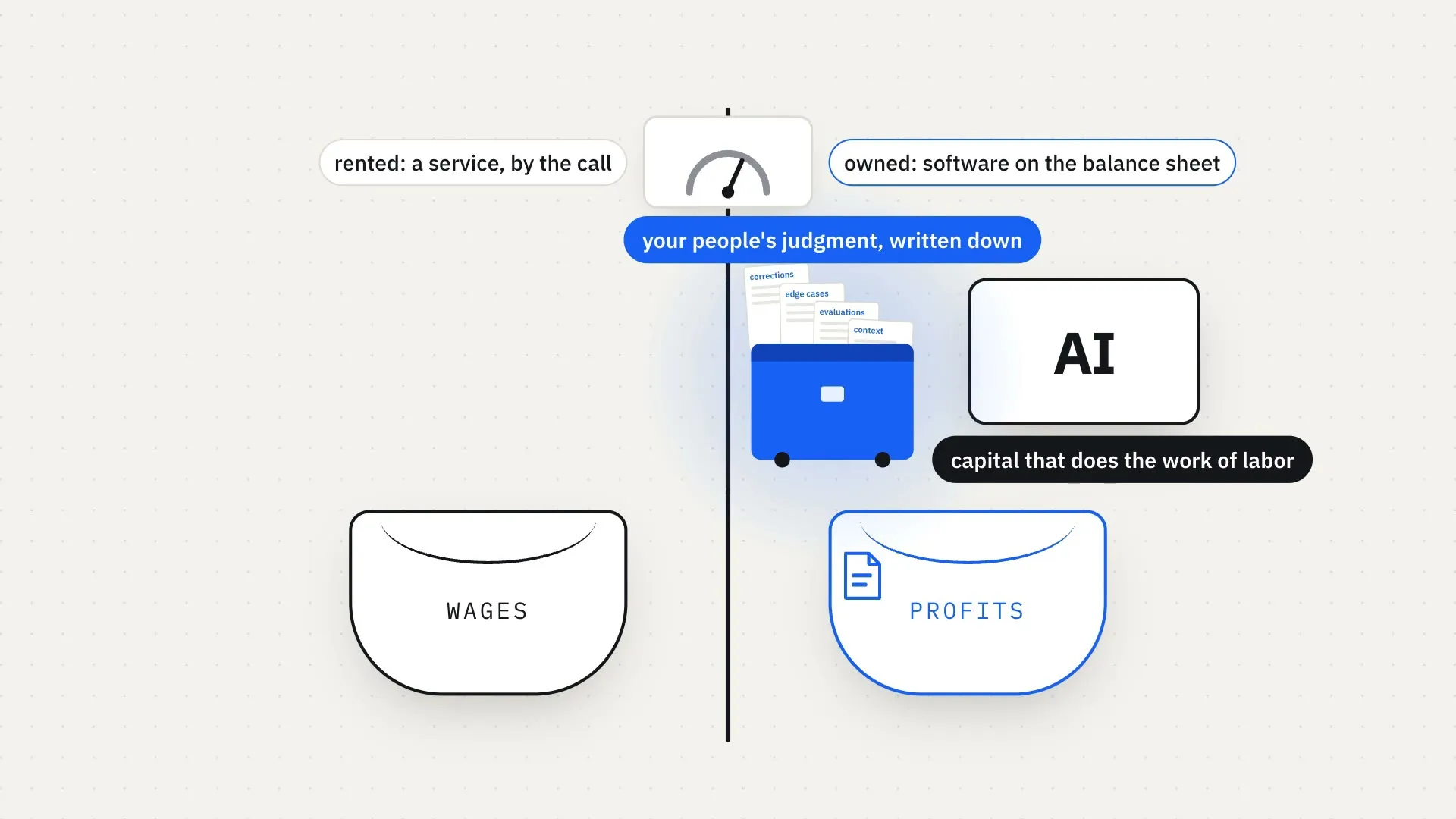
AI is capital that does the work of labor. A company can rent that work by the call, but it owns only what it can carry away: the judgment of its people, written down in a form that survives a change of model, a change of vendor, and a change of staff.
That answer matters because the line between labor and capital decides who gets paid. Wages go to the people who do the work. Profits go to whoever owns the means of doing it. For two centuries the line was easy to draw: a person could be hired but never owned, and a machine could be owned but never hired. AI sits on both sides. It drafts the contract, answers the customer, and writes the code, the way an employee does. It is also bought, owned, depreciated, and switched off, the way a machine is. So which is it, and what should a company do about the answer?
This is a long article, in eight chapters. Each one answers a single question, and together they make one argument.
Contents
- What made capital and labor different?
- Does AI do the work of labor?
- What do the books call it?
- Who gets paid when AI works?
- What is new?
- What does renting leave you holding?
- What does electricity teach?
- What should a company own, and who should share in it?
1. What made capital and labor different?
In 1821 David Ricardo, the most respected economist in England, added a chapter to the third edition of his Principles. It was called "On Machinery," and in it he changed his mind. Workers had long believed that machines hurt them. Ricardo had thought they were wrong. Now he wrote: "That the opinion entertained by the labouring class, that the employment of machinery is frequently detrimental to their interests, is not founded on prejudice and error, but is conformable to the correct principles of political economy."1
His reasoning was simple. A machine can raise the income of the people who own it while it lowers the income of the people it replaces. The two groups are paid from different pockets. Owners are paid in profit, and workers in wages. A new machine moves money from one pocket to the other.
That is the reason economists split production into two inputs. Capital is the stock of things that are made, owned, and used to make other things: buildings, machines, and, today, software. Labor is human work, paid by the hour or the year. Adam Smith measured the value of anything a person owns by the labor it could buy: its worth "is equal to the quantity of labour which it enables him to purchase or command."2 Money was valuable because it could be turned into other people's work.
The line between the two held because of one fact about people. You can buy a machine and sell it the next day. You can't buy what a person knows. Gary Becker, who made "human capital" a standard term, explained why it is capital in every sense but one: training and education produce "human, not physical or financial, capital because you cannot separate a person from his or her knowledge, skills, health, or values."3 Oliver Hart and John Moore built a theory of how companies borrow on the same fact, in a paper titled "A Theory of Debt Based on the Inalienability of Human Capital."4 Inalienable means it can't be sold, pledged, or seized. A lender can take a factory. It can't take an engineer's skill, because the skill goes home with the engineer every night.
So the old line comes down to ownership. Capital is what you can own. Labor is what you can only rent, one pay period at a time.
Eric Weinstein put the problem plainly this October, on The Diary of a CEO. He described production as "the K&L model," capital and labor, and then asked: "Well, what is AI? Is it capital? Sure looks like labor to me. Is it labor? It's not a human."5
AI does work that only people used to do, and it can be owned. That puts it on both sides of the line, and the rest of this article sorts out which side matters.
2. Does AI do the work of labor?
On some tasks, yes, and the evidence for it is better than the evidence for most claims about AI.
The broadest estimates measure potential, not results. The best known of them found that "around 80% of the U.S. workforce could have at least 10% of their work tasks affected" by language models.6 That is a statement about what the tools could touch, not about what has moved.
Field studies measure what happened. In a large customer-support operation, agents given an AI assistant resolved 15 percent more issues an hour on average, and the less experienced and less skilled agents gained about 30 percent.7 The assistant had learned from the transcripts of the best agents, and it passed their habits on to the newest ones.
Other studies found the opposite. In a randomized trial of experienced open-source developers working in code they knew well, "allowing AI actually increases completion time by 19%."8 The researchers later changed their design, because many developers refused to do tasks without AI, and said their newer data gave "an unreliable signal."9 A study of Danish workers in exposed occupations, linking surveys to payroll records, found "precise null effects on earnings and recorded hours," ruling out effects larger than 2 percent two years after.10
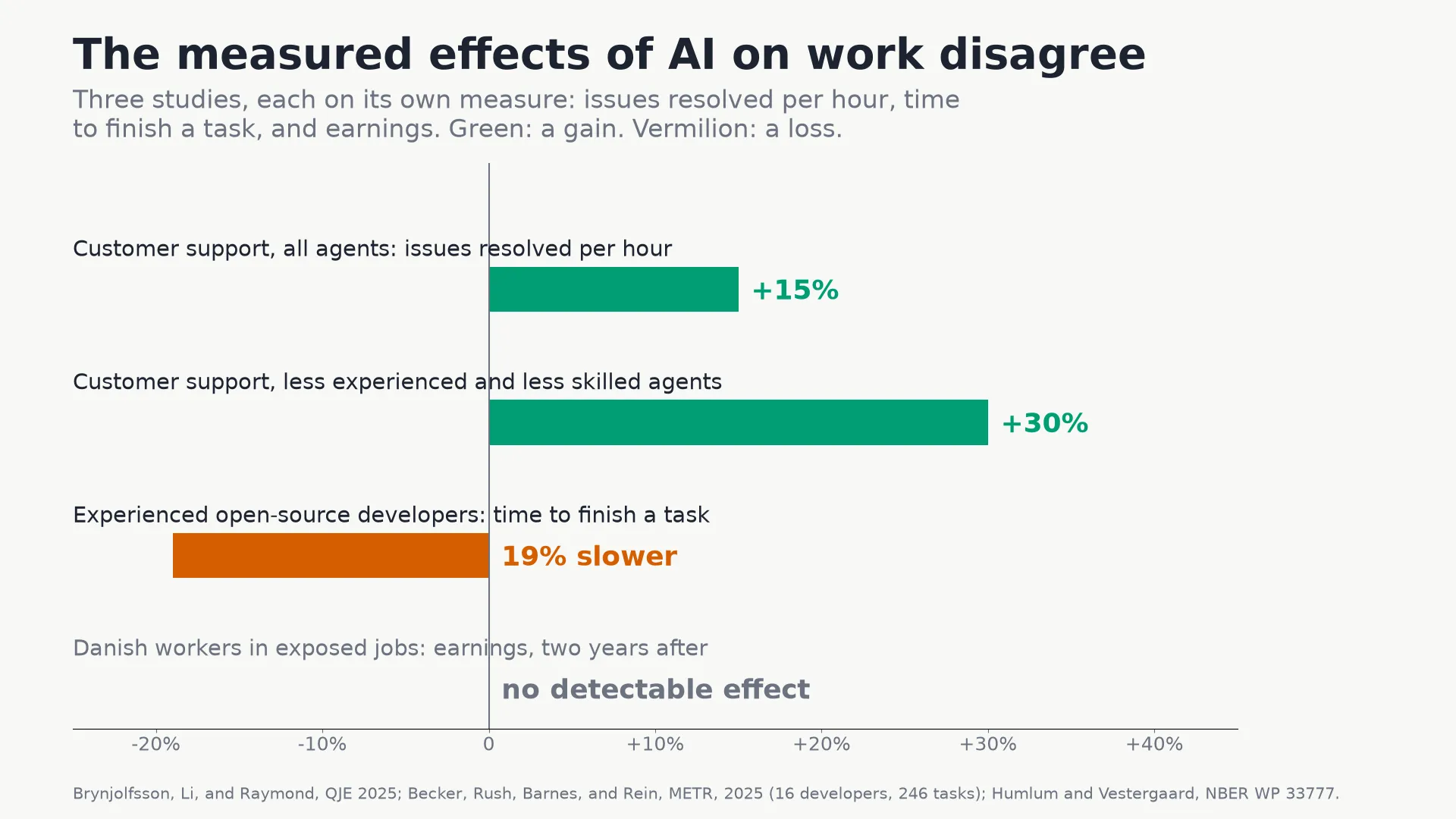
I don't read these as contradictions. The gains are largest where the work is well defined and the worker is new to it, and smallest where an expert works on something the model doesn't know. Either way, AI is doing work that people were paid to do. In that sense it substitutes for labor.
AI is also directed the way people are. You give it instructions in words, it asks for what it needs, and the newer agents carry out a task in several steps without being told each one. Nothing else a company owns behaves like that.
There is one thing AI can't do that every employee can: answer for its work.
When an airline's chatbot told a grieving customer he could claim a bereavement fare after his trip, and the airline then refused to honor it, the airline argued that the chatbot was responsible for what it said. The British Columbia Civil Resolution Tribunal called this "a remarkable submission" and wrote: "It should be obvious to Air Canada that it is responsible for all the information on its website. It makes no difference whether the information comes from a static page or a chatbot."11 In England, after lawyers cited cases that AI had invented, the High Court said that the practical measures to prevent it must be taken by "those within the legal profession with individual leadership responsibilities (such as heads of chambers and managing partners)."12 The European Union's AI Act writes the same duty into law: "Deployers shall assign human oversight to natural persons who have the necessary competence, training and authority, as well as the necessary support."13 The vendors' own terms agree. One provider's agreement says the customer "is solely responsible for all use of the Outputs."14
So AI does labor's work, but it is answered for like a machine. When it is wrong, the company that ran it is wrong.
3. What do the books call it?
Accountants and statisticians had to answer the title's question before economists did, because they had to put AI somewhere in the accounts. They have mostly answered it.
Renting AI is a service. When a company pays for a subscription or an API, it doesn't control the software it uses, so it has no asset. The IFRS Interpretations Committee settled this for cloud software in 2021: in such an arrangement "the supplier controls the application software to which the customer has access," and the customer recognizes the costs of configuring it as an expense.15 The national accounts, which measure a whole economy, treat it the same way. The 2025 System of National Accounts, the United Nations standard, says cloud computing services are primarily used "for intermediate consumption," the category for inputs that are used up, like electricity.16
Owning AI is capital. The same standard classes artificial intelligence as "a special type of software," and software is a fixed asset.17 In the United States, the accounting rules for software a company builds for itself changed in 2025: a company now capitalizes the cost once management has committed to funding the project and it is probable that the project will be completed.18 The tax code leans the same way. Since 2025, American companies may again deduct domestic research costs at once, and the law treats "any amount paid or incurred in connection with the development of any software" as research.19 Whether training a model counts as developing software, the guidance doesn't yet say.
People are not an asset. The international standard for intangible assets says that a company "usually has insufficient control over the expected future economic benefits arising from a team of skilled staff and from training for these items to meet the definition of an intangible asset."20 This is Becker's point, in an accountant's words. You can't put on the balance sheet what can walk out of the door.
Put together, the books give a working answer, and it is the one I use in the rest of this article:
- Rented AI is a purchased service, closer to electricity than to either labor or capital.
- Owned AI is capital.
- What a company learns from its people counts as capital only when the company holds it in a form it controls and can move.
That last line is the hinge of the whole question. The accounts don't separate AI's labor-like side from its machine-like side at all. The same rules cover a model, a script, and a spreadsheet macro. What they do separate, sharply, is what you control from what you don't.
4. Who gets paid when AI works?
Ricardo's question was never about definitions. It was about who gets the money.
The share of income paid to American workers is at a record low. In the nonfarm business sector, labor's share of output was 52.8 percent in the second quarter of 2026, "the lowest level ever recorded," against a range of about 60 to 66 percent for much of the postwar period.21
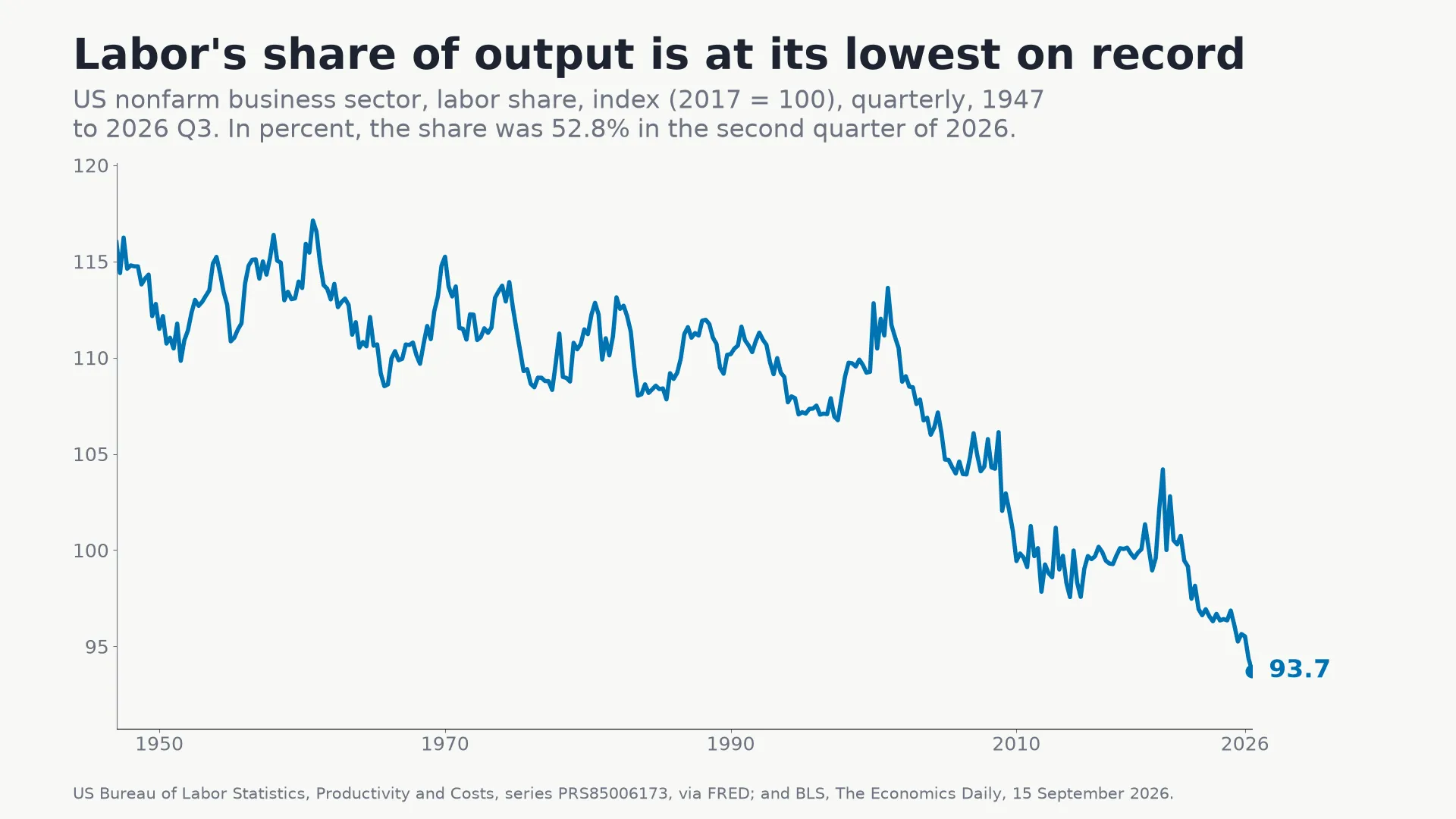
It is tempting to blame AI for that. The evidence doesn't support it yet. The economists who studied the long decline found other causes. About a third of the headline fall in one well-known study came from how the statistics impute the income of the self-employed.22 Another line of work found that sales moved toward "superstar firms" with high profits and a low share of labor in what they produce.23 All of it happened before generative AI. No study I have read attributes the recent record to AI.
The first signal that AI is reaching jobs is narrow. Employment of 22- to 25-year-olds in the occupations most exposed to AI is 19 percent below where it would have been had it kept pace with less exposed peers. The same researchers write that "We do not see widespread, economy-wide job displacement associated with AI," and call their findings descriptive.24 The young are where a change in hiring would show first, so this is worth watching, but it is not yet a measured effect on pay.
The gains to the economy as a whole may also be smaller than the talk around them. Using the task studies above, Daron Acemoglu estimated that AI's effect on total factor productivity over the next ten years "should be no more than 0.66% in total."25 Other economists expect more. But nobody has yet measured a large change in who is paid, in either direction.
Where the money is measurable, it is going upstream. The largest maker of AI chips reported a gross margin of 74.8 percent in its most recent quarter.26 A leading model provider's filing to go public shows 16.3 billion dollars of revenue in the first half of 2026, 80 percent of it billed by consumption: by the token, by the call.27 That is the price of rented AI, paid as a running cost.
Here is Ricardo's question, asked of a company instead of a worker. When a company rents all of its AI, it supplies the context, the data, and the corrections that make the AI useful, and it pays by use. The margin is taken by the people who own the chips and the models. In my view, a company in that position is closer to Ricardo's labourer than to his owner. It does the work of making the machine useful, and the machine's owners are paid for it. The difference is that a company, unlike a labourer, can choose to own part of the machine.
The next question is which part.
5. What is new?
What is new is that skill written down can be owned.
The idea of writing down what your people know is old. In 1999 three researchers at Harvard described two strategies for managing knowledge. In one, the knowledge stays with the expert and is shared person to person. In the other, called codification, knowledge "is extracted from the person who developed it, made independent of that person, and reused for various purposes."28 For decades the second strategy worked for forms and manuals, and poorly for judgment. A manual could tell you what to do. It couldn't tell you what the best person on the team would do in a case the manual missed.
AI changes that. The customer-support study in chapter 2 is the evidence: an assistant trained on the work of the best agents passed their practices to the newest ones, at a scale no manual reached.7 Judgment that lived in a few people became something the company could run.
Erik Brynjolfsson saw what this means for ownership in 2022. "When useful knowledge is inalienably locked in human brains, so too is the power it confers. But when it is made alienable, it enables greater concentration of decision-making and power."29 Zoë Cullen, Danielle Li, and Shengwu Li have since modeled it. "Firms therefore 'rent' this expertise by employing workers period by period," they write. AI changes this: "by recording how workers perform their jobs, firms can more readily codify that expertise into AI systems that can then be owned and scaled."30
That is the whole of the old line between labor and capital, crossing in one sentence. Expertise was labor because it couldn't be separated from the person. Written down in a form a model can use, it is separated, and it can be owned.
Economists have a name for what a company learns from doing its work. Edward Prescott and Michael Visscher called it organization capital in 1980: information that "is an asset to the firm" and "is produced jointly with output."31 Every correction a team makes to an AI's answer, every case it handles that the model got wrong, and every check it writes to catch the next mistake is information produced jointly with output. It is organization capital in exactly their sense.
That record is also the one input to AI that a competitor can't rent. Tom Mitchell's classic definition says a program learns "from experience E with respect to some class of tasks T and performance measure P, if its performance at tasks in T, as measured by P, improves with experience E."32 Two companies that rent the same model start from the same experience: the public data it was trained on. The only experience that is yours alone is your own, the decisions your people made and what happened after them. Written down, it is the part of AI that only you can own.
Until now, most of that capital lived in people, and that decided who was paid for it. Andrea Eisfeldt and Dimitris Papanikolaou found that in firms rich in organization capital, "the outside option of the key talent determines the share of firm cash flows that accrue to shareholders."33 Put simply, the people who carry what the firm knows can take a cut of its profits, because they could take that knowledge elsewhere. When key employees leave, the firms most exposed to them lose 8 percent of their value.34 The strongest contrary evidence is worth knowing too: star stock analysts who moved to a new firm "experienced an immediate decline in performance that persisted for at least five years."35 Much of what looks like a person's value belongs to the firm around them, and doesn't travel. Both findings say the same thing from opposite ends. Some of what a company knows is in its people, some is in its systems, and the boundary between them decides what the company keeps.
Owners of small businesses meet this boundary in its plainest form. A business that runs without its owner is an asset, and one that doesn't is a job, because what the owner knows can't be sold with it. I wrote about that test in Would your business run without you? It is the same line between labor and capital, drawn around one person. Writing down what the owner knows is how a job becomes an asset, and AI is now doing the same for the judgment spread across a company's staff.
I am not the first to draw the conclusion for a single company. Christian Catalini, Xiang Hui, and Jane Wu wrote this year that for most firms the dominant strategy is "to rent cognition—use state-of-the-art models for broad reasoning—while owning trust: strictly privatizing the domain context and the verification stack."36 Satya Nadella has written that a company using a rented model may "pay for intelligence twice, once with money, and again with something even more valuable: the proprietary knowledge you must reveal to make that intelligence useful," and that "what you create should belong to you."37 I agree with both. What I want to add is what "own" means in practice, because that is decided by contracts, and by history, more than by theory.
6. What does renting leave you holding?
More than most people think, and less than they need.
The usual worry about renting AI is that the provider trains its models on your data. For business customers, the main providers have mostly closed that door. One provider's commercial terms say it "may not train models on Customer Content from Services."38 Two of the largest assign the outputs to the customer: "OpenAI hereby assigns to Customer all OpenAI's right, title, and interest, if any, in and to Output."14 Another says "Output Content is Customer Data. Microsoft does not own Customer's Output Content."39 Fine-tuned models built for a customer are, in general, for that customer's use alone. (For what reaches a provider when your team uses AI, and what it costs to run your own, see the earlier article in this series, What does it mean to own your AI?.)
So renting already buys rights. What it doesn't buy is portability and continuity: the ability to take what you built somewhere else, and the assurance that it keeps working where it is.
The weak point is the fine-tune, the version of a model adjusted to a company's own examples. It is the most direct form of codified judgment a renting company has. It is also tied to the base model it was trained on. One provider's documentation says that its fine-tuned models "will remain available for inference until their base models are deprecated," and it is closing self-serve fine-tuning to new jobs on 15 December 2026, along with its hosted prompts and its evaluation dashboard.40 Another provider's terms keep the intellectual property in a customer's modified version of its model with the provider, and license an exported copy back to the customer as software, where export is offered at all.41 I found no major closed-model provider whose standard terms let a customer download the weights of its own fine-tune.
What does it cost to move? A study of applications that migrated from one model to another found that apps built on fine-tuned models needed a median of about 700 added lines of code to move. It also estimated that 82 percent of migrations happened after the old model had already stopped working. Notice made the difference: when a provider gave a year's warning, 13 percent of migrations came too late, and when it gave a few weeks, 89 percent did.42
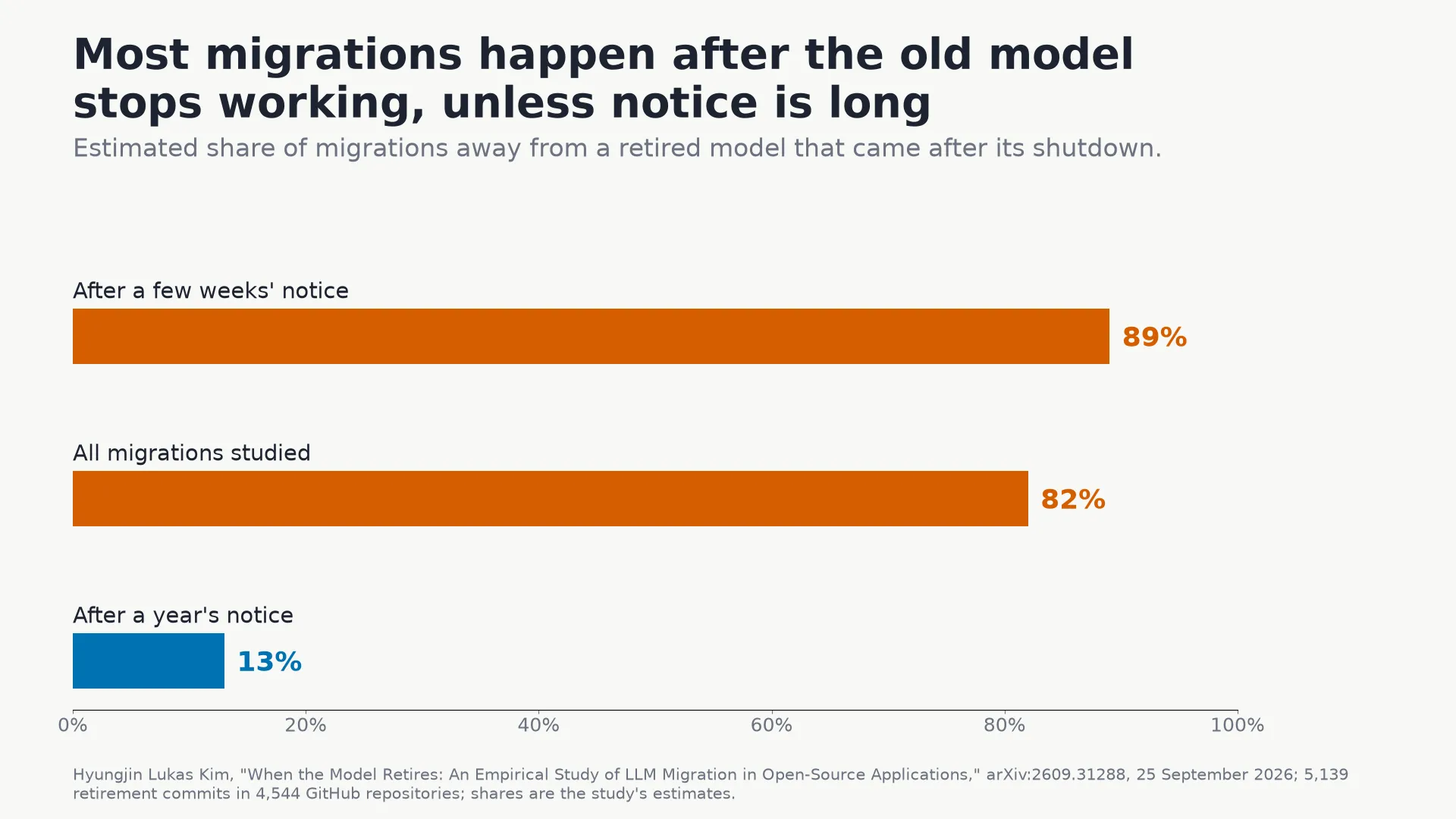
That chart is the clearest picture I know of what renting leaves out. The renter has rights to everything it made, and nowhere to take it in time. In an earlier article I called this leverage rather than lock-in: lock-in is what it costs you to leave, and leverage is what someone can do to you while you stay, such as change the model, the price, or the terms.
Open models change this part of the question. When a company runs an open model, it holds a copy of the model itself, and a version it fine-tunes on its own examples is a file it can keep, test, and run anywhere. The terms show the difference plainly. For the open models it tunes, one cloud provider's documentation says: "You can also export the tuned model from Cloud Storage and deploy it elsewhere."43 For its own proprietary models, the same provider keeps the intellectual property in the customer's version.41 Open models also stay close to the frontier: one measure put them about four months behind the best closed models in 2026.44
An open model doesn't make the model itself a scarce asset. Its license is granted to everyone, and some carry conditions; one widely used license is "non-exclusive, worldwide, non-transferable" and asks the largest companies to seek a separate license.45 Your competitors can run the same model. What open models change is where your judgment can live. Written into an open model you control, it survives a change of vendor. That makes the choice practical rather than all-or-nothing: rent the frontier for broad work, and keep what is yours in a form you can move.
7. What does electricity teach?
The closest precedent for renting AI is electric power, and it doesn't flatter people who want to own everything.
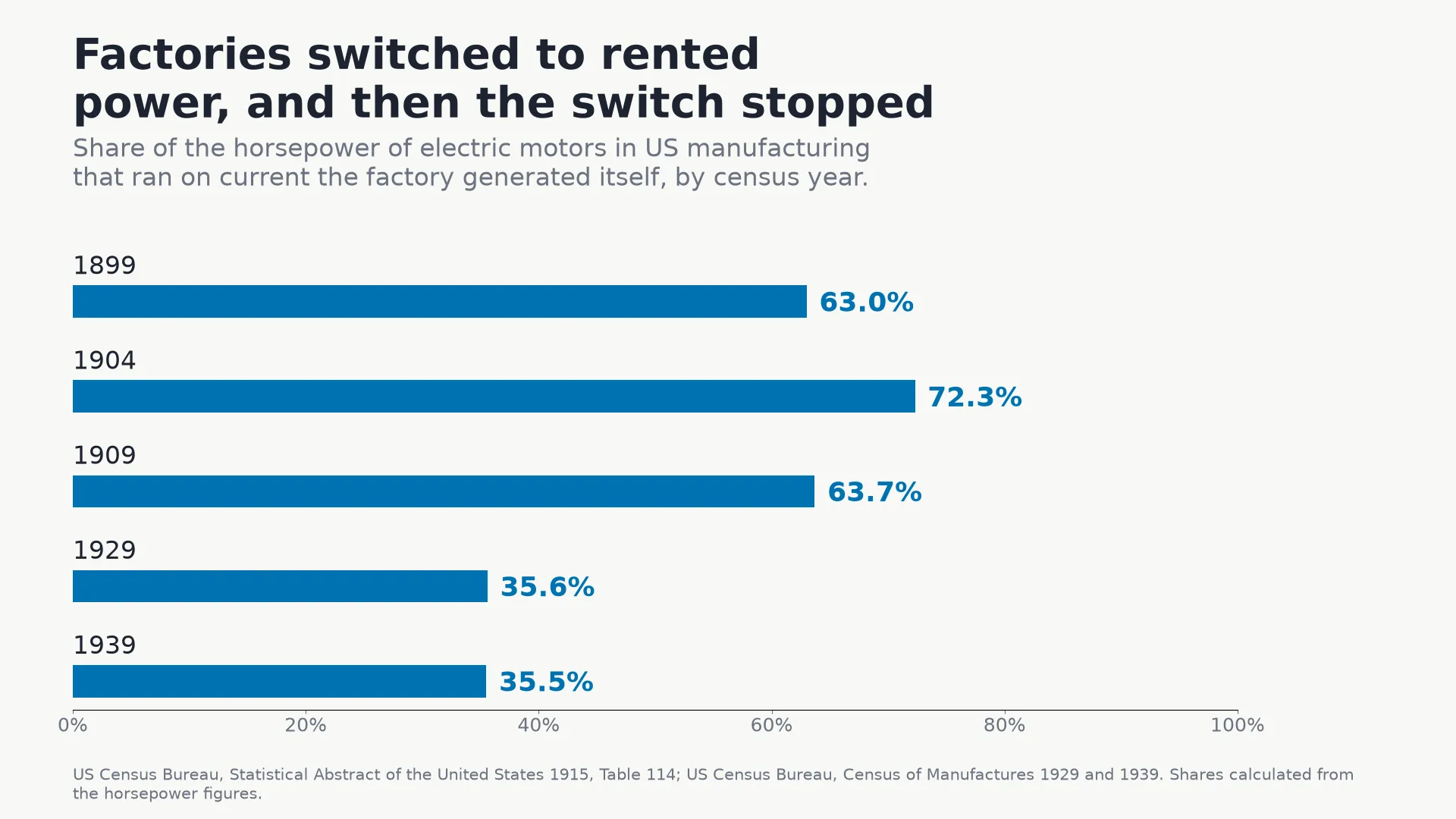
A century ago, American factories made their own electricity. In 1909, nearly two-thirds of the horsepower of electric motors in manufacturing ran on current generated in the factory itself.46 Then utilities built central stations with large steam turbines, and they could sell power more cheaply than a factory could make it. By 1929 the share of motor horsepower on plant-generated power had fallen to about a third.46
The factories that kept their own plants were not foolish. Some had equipment they weren't ready to write off. Utilities were "less successful in selling mechanical drive services to firms that already generated their own electricity than to those that were building new facilities," the historian Warren Devine found, because "few manufacturers were willing to write off installed equipment prematurely."47
But the shift also stopped. From 1929 to 1939 the plant-generated share barely moved, at about 35 percent.46 And the factories that still make their own power today have a particular reason. In 2018, onsite generation supplied about 15 percent of the electricity American manufacturers used, and about 96 percent of it came from combined heat and power: plants that make electricity from the steam their own processes produce anyway.48 They generate power because it is a by-product of what they already do.
Cloud computing followed the same course, with a lesson for the renter. Firms that moved to rented cloud computing improved their productivity with it "by 33% in the first year after adoption, and reach a stable level only after four years," and the improvements stayed mostly inside the division that made them, "with minimal knowledge transfer across divisions."49 Renting the infrastructure was easy. Learning to use it well took years, and the learning lived in teams.
The computer itself taught the same lesson a generation earlier. In a study of more than a thousand large firms from 1987 to 1997, each dollar invested in computers was associated with more than ten dollars of market value, against just over one dollar for each dollar invested in other tangible assets.50 The authors read the difference as the value of what firms built around the machines: new processes, new skills, and new ways of organizing work. Investors were paying for the organization, not the hardware.
Two lessons follow for AI. First, rent the generic input. The price of a given level of AI capability falls very quickly; one measure found declines "ranging from 9x to 900x per year," depending on the task.51 Training your own general model to save money is the factory power plant in 1915. Second, own what your operations produce anyway. The corrections, the edge cases, the evaluations, and the context your work creates are the steam from your own process. They are yours to keep, if you keep them.
8. What should a company own, and who should share in it?
If what a company can own is the codified judgment of its people, the first question is whose it is.
The law's default is clear in the United States. For work made for hire, "the employer or other person for whom the work was prepared is considered the author."52 A company owns what its employees make in the course of their jobs, including the records an AI learns from. What the employee knows stays with them. Federal trade-secret law forbids an injunction that would stop a person from taking a new job, and requires conditions on them to be based "on evidence of threatened misappropriation and not merely on the information the person knows."53
So the company owns the record, and the person keeps the knowledge. The trouble is that the record is only as good as what people choose to put into it.
Cullen, Li, and Li found that when the firm owns the data, "workers rationally withhold knowledge."30 In their experiment, more people refused to share their work for a payment when they were told it would train an AI.30 In their model, "collective data ownership achieves the first-best outcome," because people contribute what they know when they share in what it earns.30 That is a model, not a measured result. But anyone who has run a team knows the behavior it describes. People share what they know when they trust what will be done with it.
Weinstein has proposed the boldest answer. Before AI, he argued, workers whose wages fall when an employer hires from abroad should be paid a license for the right to do it. Then he extended the idea: "In this model, AI becomes just another supplier of labor. The workers license that." He sees the record AI learns from as taken, not given: "the corpus, all of human achievement has been tokenized."5
I won't argue for a particular scheme here. The legal default favors the company, and a board doesn't need to change it to see the risk. A company that codifies its people's judgment without settling with them will get a thinner record, from people who know what it is for. A company that settles with them (in pay, in credit, in a share of what the system earns, or simply in a clear promise about how it will be used) will get a better one. Price that difference the way you would price any other risk to an asset.
Then decide what to own. Here is the test I would put to a board:
- Rent the cognition. Use the best general models you can buy, and expect their price to keep falling. Don't train your own general model to own capability.
- Own what you can carry away. The corrections, the evaluations, the edge cases, the examples of good work, and the context your people supply are your organization capital. Keep them in a form that survives a change of model, a change of vendor, and a change of staff: in your own systems and, where a model has to learn them, in an open model you control. If they live only on a provider's platform, or only in a fine-tune you can't export, you rent them too.
- Fund it like an investment. If what you codify is capital, treat the spending as an investment: write down the return you expect before the money moves, and check it as you go.
- Plan the work, not the head. Budget AI against the tasks it does, beside the people who do the rest. Putting AI in the software line hides the trade-off. Counting it as headcount pretends it answers for its work, which it doesn't.
- Assign the answering. Someone in the company is responsible for every AI output that reaches a customer, a court, or a regulator. Name them before the first mistake, not after.
- Settle with your people. Tell them what is being codified and what they get for it.
So, is AI labor or capital? It is capital that does the work of labor. Rented, it is a service you pay for by the call, like electricity. Owned, it is software on the balance sheet. And the part of it that is truly new, the part that crosses Ricardo's line, is your people's judgment, written down. That is the one piece of your AI you can own. Keep it in a form you can carry away, and agree with your people on what it is worth.
Notes
- Ricardo, On the Principles of Political Economy and Taxation, 3rd ed. (1821), ch. 31, "On Machinery." ↩
- Smith, The Wealth of Nations (1776), Book I, ch. 5. ↩
- Becker, Human Capital, 3rd ed. (1994), introduction. ↩
- Hart and Moore, "A Theory of Debt Based on the Inalienability of Human Capital" (1994). ↩
- Eric Weinstein, interviewed by Steven Bartlett, The Diary of a CEO, 12 October 2026, at about 30:11 (capital and labor) and 21:40–25:30 (licensing). Quoted from a third-party transcript; the wording is confirmed by the author. ↩
- Eloundou, Manning, Mishkin, and Rock, "GPTs are GPTs" (2023). An estimate of exposure, not of work moved. ↩
- Brynjolfsson, Li, and Raymond, "Generative AI at Work" (2025). Issues resolved per hour, the published figures. ↩
- Becker, Rush, Barnes, and Rein, "Measuring the Impact of Early-2025 AI on Experienced Open-Source Developer Productivity" (2025). 16 developers, 246 tasks. ↩
- METR, "We are Changing our Developer Productivity Experiment Design" (2026). ↩
- Humlum and Vestergaard, "Large Language Models, Small Labor Market Effects" (2025, revised 2026). ↩
- Moffatt v. Air Canada, 2024 BCCRT 149. ↩
- R (Ayinde) v London Borough of Haringey, [2025] EWHC 1383 (Admin), para. 9. ↩
- Regulation (EU) 2024/1689 (the AI Act), Article 26(2). ↩
- OpenAI, Services Agreement (effective 1 January 2026), sections 4.1 and 4.3. ↩
- IFRS Interpretations Committee, agenda decision, "Configuration or Customisation Costs in a Cloud Computing Arrangement" (2021). ↩
- United Nations et al., System of National Accounts 2025, para. 22.12. ↩
- System of National Accounts 2025, paras. 11.112 and 22.35. ↩
- FASB, Accounting Standards Update 2025-06 (September 2025). Effective for annual periods beginning after 15 December 2027. ↩
- Internal Revenue Service, Revenue Procedure 2025-28, on Section 174A(d)(3). ↩
- IAS 38 Intangible Assets, para. 15. ↩
- US Bureau of Labor Statistics, The Economics Daily, 15 September 2026. Share of nonfarm business sector output paid to workers as compensation. ↩
- Elsby, Hobijn, and Şahin, "The Decline of the U.S. Labor Share" (2013). ↩
- Autor, Dorn, Katz, Patterson, and Van Reenen, "The Fall of the Labor Share and the Rise of Superstar Firms" (2020). ↩
- Brynjolfsson, Chandar, and Chen, "Canaries in the Coal Mine?" (August 2026 version). ADP payroll records. ↩
- Acemoglu, "The Simple Macroeconomics of AI" (2024). A model-based estimate, not a measurement. ↩
- NVIDIA, Form 8-K, 17 November 2026. GAAP gross margin, quarter ended 25 October 2026. ↩
- Anthropic, Form S-1, 26 October 2026. Revenue for the six months ended 30 June 2026. ↩
- Hansen, Nohria, and Tierney, "What's Your Strategy for Managing Knowledge?" (1999). ↩
- Brynjolfsson, "The Turing Trap" (2022). ↩
- Cullen, Li, and Li, "Labor as Capital: AI and the Ownership of Expertise" (2026), a preliminary working paper. ↩
- Prescott and Visscher, "Organization Capital" (1980). ↩
- Mitchell, Machine Learning (1997), 2. ↩
- Eisfeldt and Papanikolaou, "Organization Capital and the Cross-Section of Expected Returns" (2013). ↩
- Israelsen and Yonker, "Key Human Capital" (2017). ↩
- Groysberg, Lee, and Nanda, "Can They Take It with Them?" (2008). ↩
- Catalini, Hui, and Wu, "Some Simple Economics of AGI" (2026), section 8.2.2. ↩
- Nadella, "The Reverse Information Paradox" (12 July 2026). ↩
- Anthropic, Commercial Terms of Service (as of 28 November 2026). ↩
- Microsoft, Product Terms, Universal License Terms for Online Services (as of 28 November 2026). ↩
- OpenAI, API deprecations page (as of 28 November 2026). ↩
- Google Cloud, Service Specific Terms (as of 28 November 2026). ↩
- Kim, "When the Model Retires" (2026). 5,139 retirement commits in 4,544 open-source repositories; the shares are the study's estimates. ↩
- Google Cloud, "Tune an open model" documentation (updated 20 November 2026). ↩
- Edwards and Emberson, "Open Models Lag State-of-the-Art Closed Models by 4 Months" (2026). ↩
- Meta, Llama 4 Community License Agreement (2025). ↩
- US Census Bureau, Statistical Abstract of the United States (1915), and Census of Manufactures, 1929 and 1939. Horsepower of electric motors in manufacturing, by source of current. ↩
- Devine, "From Shafts to Wires" (1983). ↩
- US Energy Information Administration, Manufacturing Energy Consumption Survey (2018). ↩
- Brand, Demirer, Finucane, and Kreps, "Firm Productivity and Learning with Digital Technologies" (2024, revised 2025). ↩
- Brynjolfsson, Hitt, and Yang, "Intangible Assets: Computers and Organizational Capital" (2002). ↩
- Cottier, Snodin, Owen, and Adamczewski, "LLM inference prices have fallen rapidly but unequally across tasks" (2025). ↩
- 17 U.S.C. § 201(b). ↩
- 18 U.S.C. § 1836(b)(3)(A)(i) (the Defend Trade Secrets Act). ↩
Bibliography
- Acemoglu, Daron. 2024. "The Simple Macroeconomics of AI." NBER Working Paper 32487. https://www.nber.org/system/files/working_papers/w32487/w32487.pdf.
- Anthropic, PBC. 2026. Form S-1 Registration Statement. Filed 26 October 2026. https://www.sec.gov/Archives/edgar/data/2130357/000162828026067168/anthropicpbc-sx1.htm.
- Anthropic. 2026. "Commercial Terms of Service." https://www.anthropic.com/legal/commercial-terms.
- Autor, David, David Dorn, Lawrence F. Katz, Christina Patterson, and John Van Reenen. 2020. "The Fall of the Labor Share and the Rise of Superstar Firms." Quarterly Journal of Economics 135 (2). https://www.nber.org/system/files/working_papers/w23396/w23396.pdf.
- Ayinde, R (on the application of) v The London Borough of Haringey. 2025. [2025] EWHC 1383 (Admin), 6 June. https://caselaw.nationalarchives.gov.uk/ewhc/admin/2025/1383.
- Becker, Gary S. 1994. Human Capital. 3rd ed. Chicago: University of Chicago Press. https://www.nber.org/system/files/chapters/c11229/c11229.pdf.
- Becker, Joel, Nate Rush, Beth Barnes, and David Rein. 2025. "Measuring the Impact of Early-2025 AI on Experienced Open-Source Developer Productivity." arXiv:2507.09089. https://arxiv.org/abs/2507.09089.
- Brand, James, Mert Demirer, Connor Finucane, and Avner Kreps. 2024. "Firm Productivity and Learning with Digital Technologies: Evidence from Cloud Computing." NBER Working Paper 32938, revised 2025. https://www.nber.org/papers/w32938.
- Brynjolfsson, Erik. 2022. "The Turing Trap: The Promise and Peril of Human-Like Artificial Intelligence." Daedalus 151 (2). https://arxiv.org/abs/2201.04200.
- Brynjolfsson, Erik, Bharat Chandar, and Ruyu Chen. 2026. "Canaries in the Coal Mine? Six Facts about the Recent Employment Effects of Artificial Intelligence." Stanford Digital Economy Lab, August. https://digitaleconomy.stanford.edu/app/uploads/2026/08/Canaries_August2026.pdf.
- Brynjolfsson, Erik, Lorin M. Hitt, and Shinkyu Yang. 2002. "Intangible Assets: Computers and Organizational Capital." Brookings Papers on Economic Activity 2002 (1).
- Brynjolfsson, Erik, Danielle Li, and Lindsey Raymond. 2025. "Generative AI at Work." Quarterly Journal of Economics 140 (2). https://www.nber.org/papers/w31161.
- Catalini, Christian, Xiang Hui, and Jane Wu. 2026. "Some Simple Economics of AGI." arXiv:2602.20946. https://arxiv.org/abs/2602.20946.
- Cottier, Ben, Ben Snodin, David Owen, and Tom Adamczewski. 2025. "LLM Inference Prices Have Fallen Rapidly but Unequally across Tasks." Epoch AI, 12 March. https://epoch.ai/data-insights/llm-inference-price-trends.
- Cullen, Zoë B., Danielle Li, and Shengwu Li. 2026. "Labor as Capital: AI and the Ownership of Expertise." Harvard Business School Working Paper 26-063, preliminary. https://www.hbs.edu/ris/Publication%20Files/26-063_6b332c34-be84-4af4-9d29-1107d22419e9.pdf.
- Devine, Warren D., Jr. 1983. "From Shafts to Wires: Historical Perspective on Electrification." Journal of Economic History 43 (2): 347–372.
- Eisfeldt, Andrea L., and Dimitris Papanikolaou. 2013. "Organization Capital and the Cross-Section of Expected Returns." Journal of Finance 68 (4).
- Eloundou, Tyna, Sam Manning, Pamela Mishkin, and Daniel Rock. 2023. "GPTs Are GPTs: An Early Look at the Labor Market Impact Potential of Large Language Models." arXiv:2303.10130. https://arxiv.org/abs/2303.10130.
- The Diary of a CEO. 2026. "UFO Cover-Up Analyst: The Secret Alien Programs Nobody Is Talking About! | Eric Weinstein." Hosted by Steven Bartlett. YouTube video, 12 October. https://www.youtube.com/watch?v=IkhmdTqSvJw.
- Edwards, Jack, and Luke Emberson. 2026. "Open Models Lag State-of-the-Art Closed Models by 4 Months." Epoch AI, 29 May. https://epoch.ai/data-insights/open-closed-eci-gap.
- Elsby, Michael W. L., Bart Hobijn, and Ayşegül Şahin. 2013. "The Decline of the U.S. Labor Share." Federal Reserve Bank of San Francisco Working Paper 2013-27. https://www.frbsf.org/wp-content/uploads/wp2013-27.pdf.
- European Union. 2024. Regulation (EU) 2024/1689 (Artificial Intelligence Act). Official Journal of the European Union, 12 July. https://eur-lex.europa.eu/eli/reg/2024/1689/oj/eng.
- FASB (Financial Accounting Standards Board). 2025. Accounting Standards Update 2025-06, Intangibles—Goodwill and Other—Internal-Use Software. September. https://fasb.org/projects/recently-completed-projects/accounting-for-and-disclosure-of-software-costs.
- Google Cloud. 2026a. "Tune an Open Model." Documentation, updated 20 November. https://docs.cloud.google.com/gemini-enterprise-agent-platform/models/tuning/open-model-tuning.
- Google Cloud. 2026b. "Service Specific Terms." https://cloud.google.com/terms/service-terms.
- Groysberg, Boris, Linda-Eling Lee, and Ashish Nanda. 2008. "Can They Take It with Them? The Portability of Star Knowledge Workers' Performance." Management Science 54 (7): 1213–1230.
- Hansen, Morten T., Nitin Nohria, and Thomas Tierney. 1999. "What's Your Strategy for Managing Knowledge?" Harvard Business Review 77 (2): 106–116.
- Hart, Oliver, and John Moore. 1994. "A Theory of Debt Based on the Inalienability of Human Capital." Quarterly Journal of Economics 109 (4): 841–879.
- Humlum, Anders, and Emilie Vestergaard. 2025. "Large Language Models, Small Labor Market Effects." NBER Working Paper 33777, revised 2026 as "Still Waters, Rapid Currents." https://www.nber.org/papers/w33777.
- IFRS Foundation. 2018, as amended. IAS 38 Intangible Assets. https://www.endorsement-board.uk/docs/2179/html/.
- IFRS Interpretations Committee. 2021. "Configuration or Customisation Costs in a Cloud Computing Arrangement (IAS 38 Intangible Assets)." Agenda decision, April.
- Internal Revenue Service. 2025. Revenue Procedure 2025-28. https://www.irs.gov/pub/irs-drop/rp-25-28.pdf.
- Israelsen, Ryan D., and Scott E. Yonker. 2017. "Key Human Capital." Journal of Financial and Quantitative Analysis 52 (1): 175–214.
- Kim, Hyungjin Lukas. 2026. "When the Model Retires: An Empirical Study of LLM Migration in Open-Source Applications." arXiv:2609.31288. https://arxiv.org/abs/2609.31288.
- Meta. 2025. "Llama 4 Community License Agreement." https://www.llama.com/llama4/license/.
- Microsoft. 2026. "Product Terms: Universal License Terms for Online Services." https://www.microsoft.com/licensing/terms/product/ForAllOnlineServices.
- Mitchell, Tom M. 1997. Machine Learning. New York: McGraw-Hill.
- Moffatt v. Air Canada. 2024. 2024 BCCRT 149 (Civil Resolution Tribunal of British Columbia), 14 February.
- Nadella, Satya. 2026. "The Reverse Information Paradox." sn scratchpad, 12 July. https://snscratchpad.com/posts/reverse-information-paradox/.
- NVIDIA Corporation. 2026. Form 8-K, Exhibit 99.1, 17 November. https://www.sec.gov/Archives/edgar/data/1045810/000104581026000088/q3fy27pr.htm.
- OpenAI. 2026a. "Deprecations." https://platform.openai.com/docs/deprecations.
- OpenAI. 2026b. "Services Agreement." Effective 1 January 2026. https://openai.com/policies/services-agreement/.
- Prescott, Edward C., and Michael Visscher. 1980. "Organization Capital." Journal of Political Economy 88 (3): 446–461. https://doi.org/10.1086/260879.
- Ricardo, David. 1821. On the Principles of Political Economy and Taxation. 3rd ed. London: John Murray. https://www.econlib.org/library/Ricardo/ricP.html.
- Smith, Adam. 1776. An Inquiry into the Nature and Causes of the Wealth of Nations. https://www.gutenberg.org/files/3300/3300-h/3300-h.htm.
- United Nations, European Commission, IMF, OECD, and World Bank. 2025. System of National Accounts 2025.
- US Bureau of Labor Statistics. 2026. "Labor Share at Its Lowest Level, 52.8 Percent, in Second Quarter 2026." The Economics Daily, 15 September. https://www.bls.gov/opub/ted/2026/labor-share-at-its-lowest-level-52-8-percent-in-second-quarter-2026.htm.
- US Bureau of Labor Statistics. 2026. "Nonfarm Business Sector: Labor Share for All Workers" (PRS85006173). Via FRED, Federal Reserve Bank of St. Louis. https://fred.stlouisfed.org/series/PRS85006173.
- US Census Bureau. 1916. Statistical Abstract of the United States 1915, Table 114. https://www2.census.gov/library/publications/1916/compendia/statab/38ed/1915-03.pdf.
- US Census Bureau. 1933 and 1942. Census of Manufactures, 1929 and 1939: power equipment.
- US Code. 17 U.S.C. § 201(b), works made for hire.
- US Code. 18 U.S.C. § 1836(b)(3)(A)(i), the Defend Trade Secrets Act. https://www.govinfo.gov/content/pkg/USCODE-2023-title18/pdf/USCODE-2023-title18-partI-chap90-sec1836.pdf.
- US Energy Information Administration. 2026. "Use of Energy Explained: Energy Use in Industry" (2018 Manufacturing Energy Consumption Survey). https://www.eia.gov/energyexplained/use-of-energy/industry-in-depth.php.