
What does it mean to own your AI?
Steve Sperandeo ·
Watch the twenty-five-minute film
Owning your AI isn't about owning a data center. It means that nobody else holds leverage over what your company knows, how its AI behaves, or what it costs. And it is the only way your AI learns from your experience for your benefit alone.
That sounds abstract until you look at what happens when your team uses AI today. Every prompt carries something your company knows out to a model someone else runs. The model is a compression of the data it was trained on. The company that runs it decides how it changes, when it retires, and what it charges. None of that is sinister. Most of it is in the terms. But it adds up to a question every leader should be able to answer: which parts of our AI are ours?
This is a long article, in nine chapters. Each one answers a single question, and together they make one argument. It isn't a case against renting AI. Frontier models are extraordinary, and I use them every day. It's a way to decide, workload by workload, what to own and what to rent, and whether the question belongs on your list this year at all.
Contents
- What leaves the building when your team uses AI?
- Are you talking to the model, or to its data?
- Which promises can you keep?
- What is sovereignty, if it isn't where your data sits?
- What does owning let you do that renting never will?
- What does it cost?
- Is lock-in the risk?
- When is renting the right call?
- Is it one of your top three?
First, what I mean by the words. To own your AI is to control where it runs, which models it uses and how they change, what data reaches them, and who benefits from what they learn. It doesn't require buying hardware. Servers you rent in a public or private cloud, but control, are your own infrastructure in every way that matters here. To rent AI is to use a model through someone else's interface or API, where they control the model and how it runs.
1. What leaves the building when your team uses AI?
When your team uses an AI agent, it sends prompts. Inside those prompts is your company: a contract clause, a customer complaint, a pricing model, a block of source code, an early version of next quarter's plan. The prompt goes out to a model someone else runs, and the answer comes back and mixes into your work. Every prompt is a small shipment of what your company knows.
Agents make the shipments larger. A person pastes one paragraph. An agent reads a whole folder, a code repository, or a customer's history, decides for itself what's relevant, and sends it along as context. That's what makes agents so useful, and it's also why the question of where the model runs has become a question about most of what the company knows, not just what someone chose to type.
Where it goes next depends on the plan. Here the terms have settled into two camps, and it's worth being exact.
Consumer plans can train on what you type, and most do by default. OpenAI's privacy policy says it may use the content you provide "to train the models that power ChatGPT," and offers an opt-out.1 Anthropic, which once didn't train on consumer chats, changed its terms in 2025: conversations on its Free, Pro, and Max plans can now be used for training, at the user's choice, and kept for up to five years when they are.2 Google's unpaid Gemini API goes further: what you submit is used to improve and develop Google's products, including its enterprise features, and human reviewers may read it.3
Business and API plans don't train on your data by default. OpenAI hasn't trained on business or API data by default since March 2023, though it keeps API inputs and outputs for up to 30 days to watch for abuse, unless an eligible customer has arranged zero retention.4 Anthropic's commercial terms likewise bar training on customer content.5 Most large providers now draw the line in the same place.
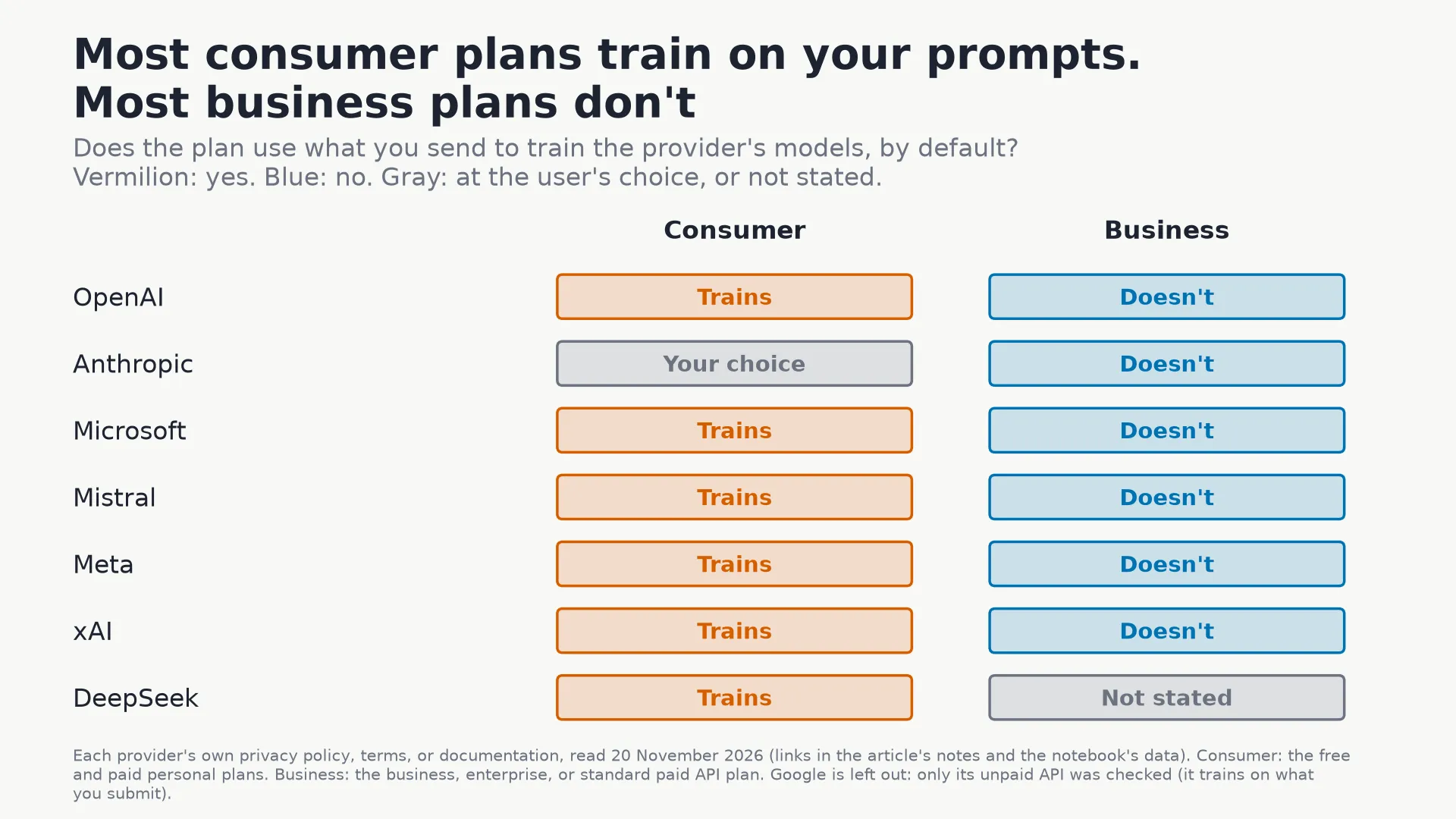
So the risk is not that "everything you type is trained on." It's narrower, and more ordinary than that. It is in three places.
The first is personal accounts. People use what's fastest. In one study of 222 companies, roughly a third of employees reached AI tools through personal accounts rather than the company's.6 A business plan protects nothing typed into a personal one.
The second is what's kept. Logs kept for abuse monitoring, conversations saved when someone clicks a feedback button, data held under a court's preservation order: each is a copy of your company outside your company.7
The third is what you can see. When you rent, your view stops at the provider's door. A typical data processing agreement lets you audit the provider about once a year, at your own expense, or accept its auditors' reports instead. Nothing in it lets you inspect the model, its training data, or the hardware your prompts ran on.8
The best-known case shows how this usually goes. In 2023, Samsung told its staff that "we are temporarily restricting the use of generative AI," after engineers uploaded sensitive source code to ChatGPT. Bloomberg, which reviewed the memo, reported the company's concern: data sent to these services is stored on external servers, is difficult to retrieve and delete, and could end up disclosed to other users.9 Notice what the memo doesn't say. Nobody showed that the code came back out of the model. The problem was simpler: it had left, and Samsung couldn't get it back.
2. Are you talking to the model, or to its data?
When you talk to a model, you're really talking to a corpus of data. The model is the code that brings the data to life. It's a way of compressing the world's text and pulling patterns out of it, whether those patterns look like reasoning, like recall, or like something in between.
That isn't a metaphor. Predicting the next word and compressing data are, mathematically, the same problem. A team at Google DeepMind showed it directly: a large language model, trained mostly on text, compressed images and audio better than the tools built for them, PNG and FLAC.10 Another group measured how much a model of this kind can memorize outright, and put it at about 3.6 bits for every parameter.11 A model is, in part, a library in a very small box.
The idea is easier than it sounds. If you can predict the next word of a sentence well, you don't need to store that word; you only need to store the few cases where your guess was wrong. The better the prediction, the smaller the file. So a model that predicts language well has, in effect, folded the text it learned from into its weights. When you ask it a question, you're drawing on that folded-up text: what it read, weighted by how often it read it.
That changes how to think about what you send it. A prompt isn't a question to a neutral machine. It's a contribution to a conversation with a body of data, run by a company that decides what goes into the next version of that body.
Some of what's in the box can be pulled back out word for word. Researchers extracted hundreds of verbatim passages from GPT-2's training data, including names, phone numbers, and code, some of which had appeared in only a single document.12 Later, a simple trick, asking ChatGPT to repeat one word forever, made it emit its training data at 150 times the usual rate.13 Tuning a model to be a polite assistant hides what it memorized. It doesn't erase it.
Here I want to be careful, because this is where fear usually enters. Nobody has shown a real business's prompt, sent to a commercial API that doesn't train on it, coming back out of a later model. And in a study of code models, the training methods labs use on feedback made memorization much less likely than plain fine-tuning did.14 If you were hoping for a horror story, I don't have one.
That's the point, though. The cost of not owning your AI isn't a single incident. It's quiet, it's hard to see, and it happens every day across thousands of prompts. Insight leaves your company in small pieces, through personal accounts, consumer tools, and feedback buttons, into data that improves models your competitors also use. People tend to fixate on one dramatic leak. What deserves attention is the steady, silent flow that nobody measures.
3. Which promises can you keep?
Owning your AI is, above all, a way to keep promises. A company makes different promises to different people, and each one depends on knowing where its data goes.
To your shareholders, you promise that the company's advantage isn't leaking. In law, that promise has a test. Under the US Defend Trade Secrets Act, information is a trade secret only if its owner "has taken reasonable measures to keep such information secret."15 Pasting a formula into a consumer tool whose terms allow training is hard to call a reasonable measure. No court has yet stripped a trade secret only because it went through an enterprise API with a no-training contract, but the test is the one your lawyers will be asked about.
To your clients, you promise that their information stays with you. Courts have started writing that promise down. In March 2026, a federal court in Colorado barred the parties in one case from putting confidential discovery into any AI platform unless the provider is contractually barred from storing it or training on it, and from sharing it, and will delete it on request.16 That is a fair checklist for any client's data.
To the court, if you ever end up there, the promise is privilege, and here the line is now clear. In February 2026, Judge Jed Rakoff ruled in United States v. Heppner that documents an executive had drafted with a consumer AI tool were not privileged. The tool's privacy policy allowed the provider to use what he typed for training and to disclose it to third parties, so he had, in the court's words, no "reasonable expectation of confidentiality."17 Lawyers were warned earlier: the American Bar Association said in 2024 that a client's informed consent is required before their information goes into a self-learning AI tool.18 Language models are not your lawyer, and talking to one isn't a privileged conversation.
To a regulator or a foreign government, you promise that your data answers to your law. That depends less on where the servers sit than on who controls them. The US CLOUD Act requires American providers to hand over data in their "possession, custody, or control," "regardless of whether" it is stored inside or outside the United States.19 In June 2025, the French Senate asked Microsoft France's director of public and legal affairs whether he could guarantee that French public data would never be passed to US authorities without France's consent. He answered under oath: "No, I cannot guarantee it," adding that it had never happened.20
I appreciate the honesty of that answer. It is the right answer, and it explains why running your AI on infrastructure you control matters. It's the only way to give each of these people a guarantee you can actually keep.
4. What is sovereignty, if it isn't where your data sits?
Sovereign AI is close to owning your AI, but the word carries something more: independence. Sovereignty means no one holds leverage over you. Nobody can take your control away, so you're free to make your own decisions and pursue opportunities the way you choose.
Where your data is stored is only part of that. The European Commission's framework for judging cloud sovereignty scores eight things, and data and legal jurisdiction together count for a fifth of the total. The rest is about the supply chain, operations, technology, strategy, security, and energy: who could stop you, change you, or switch you off.21 A workload can sit in a Paris data center and still depend entirely on someone else.
France shows what building that independence takes. In 2021, its domestic intelligence service, the DGSI, opened a tender for a sovereign platform to process large volumes of data. A French company won the first part at the end of 2024 and the second in June 2026, calling it a milestone "for French and European technological sovereignty."22 Five years from tender to the second award, for one platform. France decided sovereignty was worth that. It also learned how long the work takes.
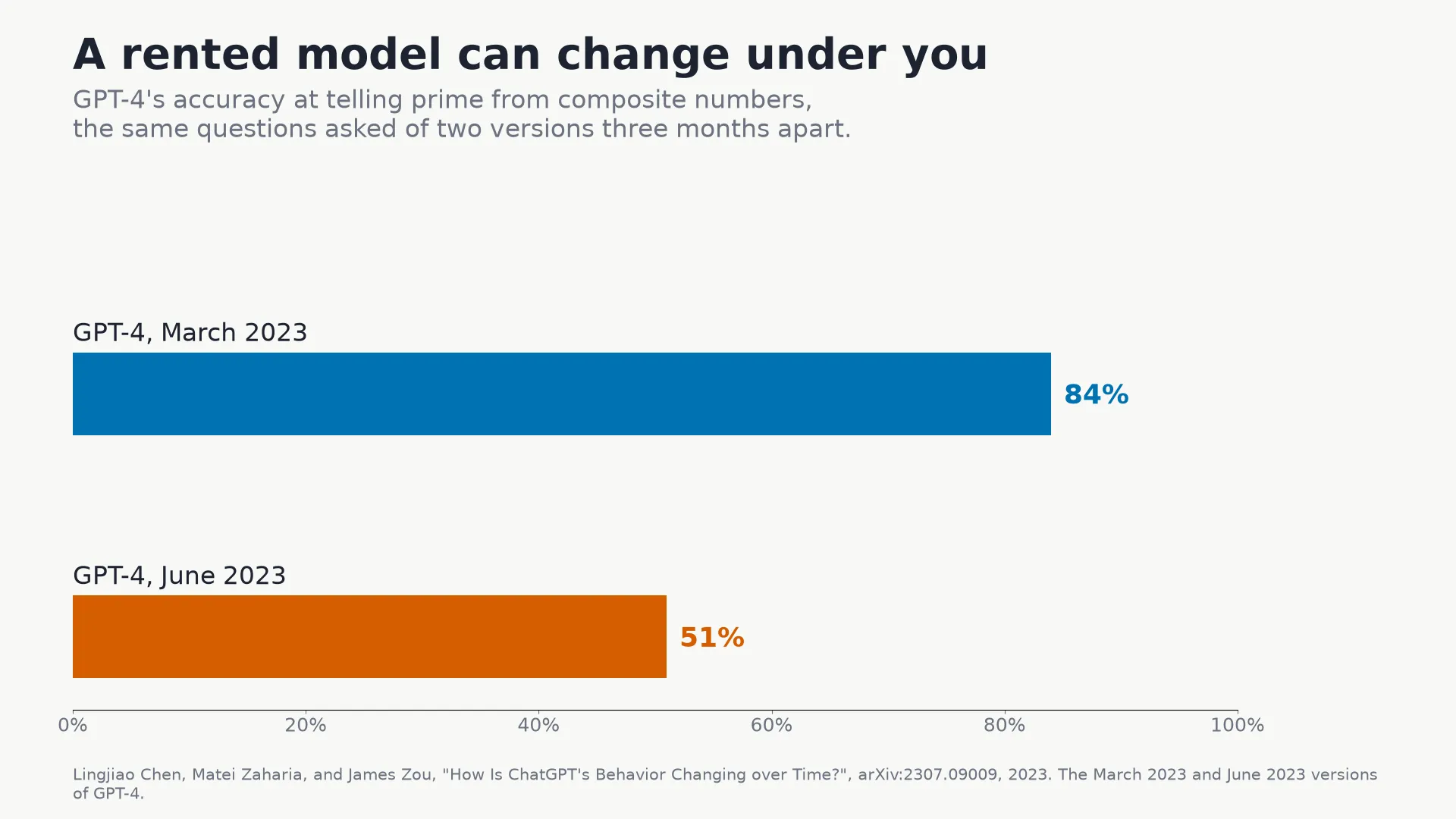
For most companies, the leverage is less dramatic and more immediate: the model itself. A model you rent is not a fixed thing. It's an endpoint that the provider updates. When researchers at Stanford and Berkeley gave the same questions to two versions of GPT-4 three months apart, its accuracy at telling prime numbers from composite ones fell from 84% to 51%.23 Nothing on the customer's side had changed.
Then models retire. OpenAI promises at least six months' notice before it shuts down a generally available model, and less for others; Anthropic promises at least 60 days.2425 That's reasonable for a company improving its products quickly. It's a problem if you need the same behavior for five years, because a regulator validated it, a clinical process depends on it, or your customers have learned to trust it.
A frontier lab can't promise you that, and it shouldn't. Its job is to make one model as generally useful as possible for as many people as possible. If you want a model that converges on your needs, your audience, your expectations, and your worldview, and stays put, you have to own it.
Owning a model means owning a file: the weights. You can store it, copy it, test it, and run it next year exactly as it ran today. When a better model appears, you decide whether to move, after you've tested it on your own work. The upgrade happens on your schedule, not because a date arrived on someone else's calendar.
5. What does owning let you do that renting never will?
This is the chapter that matters most to me, because it's the one that's about more than risk.
Start with what AI is. The classic definition comes from Tom Mitchell's 1997 textbook: a program learns "from experience E with respect to some class of tasks T and performance measure P, if its performance at tasks in T, as measured by P, improves with experience E."26 Put simply, you have AI when a task gets better as you add more data. Ordinary software doesn't have that property. You can feed a payroll program a million more records, and it won't get any better at payroll.
So the process of building a model is the process of extracting signal from data for a specific task. Signal is the information that helps you do the task better. Noise is everything that doesn't. As data flows through a good pipeline, the signal-to-noise ratio rises: you keep what helps and throw the rest away, noise first.
Now think about two competitors who rent the same frontier model. They draw on exactly the same experience, the public data it was trained on. The only experience that is yours alone is your own: your customers' outcomes, your operations, your documents, your decisions, and what happened after them. A rented general model doesn't learn from that for you. The provider isn't training on your data for your benefit only, and on business plans it isn't training on it at all. If you want a model that gets better at your work, you have to train it yourself, or with someone who knows how.
Take an insurer. Every year it settles thousands of claims, and for each one it knows what was claimed, what the adjuster found, what it paid, and whether the claim later turned out to be fraud. That history is experience in Mitchell's sense: a record of tasks, attempts, and outcomes. A model trained on it learns which claims this insurer should pay quickly and which deserve a second look, in this insurer's market, under its own policies. Next year it has another year of outcomes, and the model gets better again. A rented general model knows a great deal about insurance in general. It knows nothing about this insurer's claims, and it never will unless the insurer teaches it.
That's what I mean when I say owning your AI is about learning. Most of the data a company stores is never used for anything after the moment it's written. Training your own models on it is how that history starts to pay: the whole context of the business, compressed, with a little reasoning added to every decision that goes out, so that the company itself becomes more intelligent.
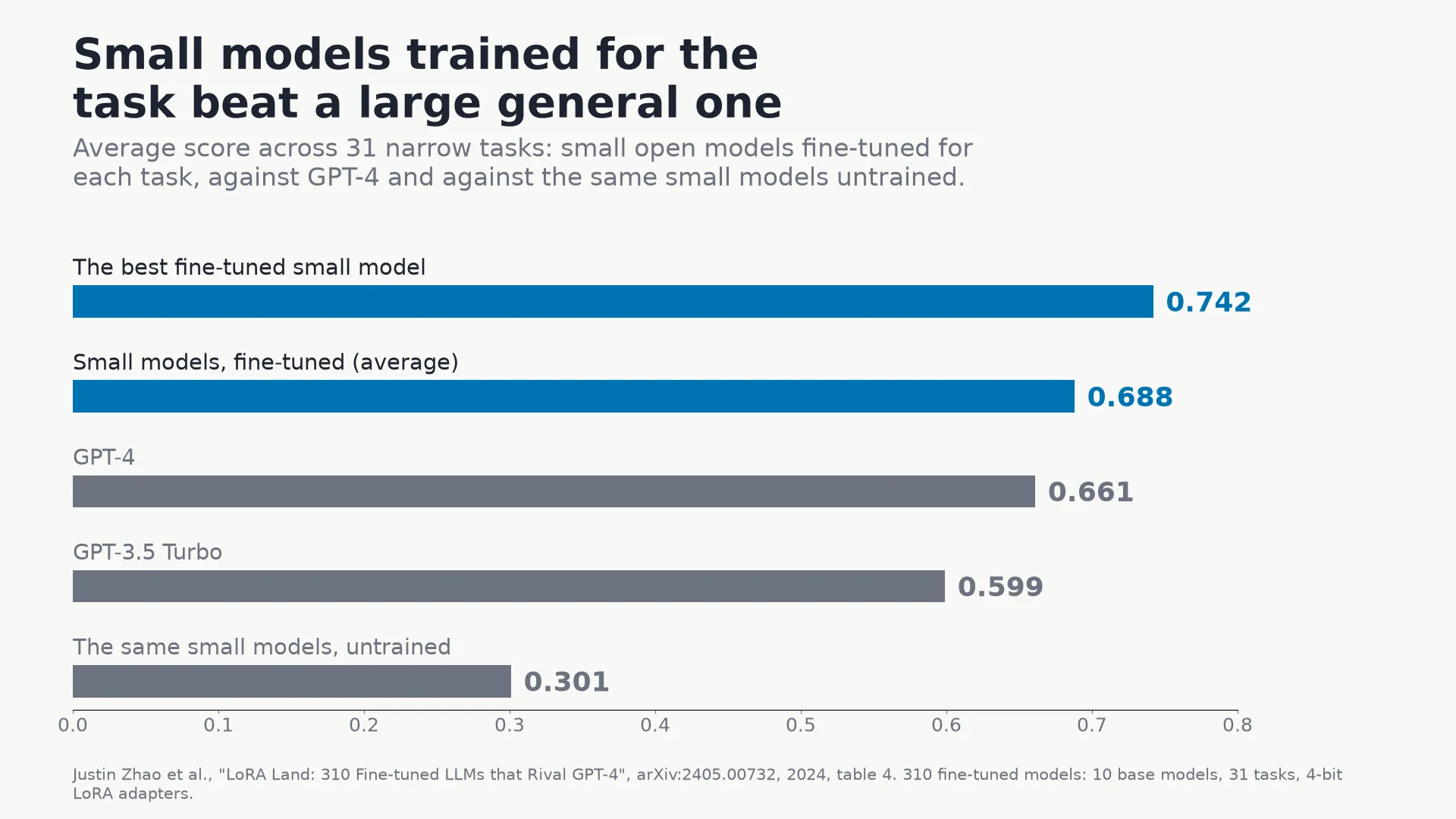
The evidence that this pays is good. In one study, researchers fine-tuned 310 small open models on 31 specific tasks. On average across those tasks, the small specialized models scored higher than GPT-4, and the best of them scored higher still; 25 of them could be served from a single GPU.27 On tables, the shape most business data takes, tree-based models still beat deep learning on typical datasets, and a newer kind of model built for tables beats both.2829
Owning also means you choose the kind of model. It could be unsupervised learning, reinforcement learning with rewards you can check, a language model, or a combination, such as a transformer with a classification head on top. You can design it the way a well-trained data scientist would. When you rent, the architecture is fixed. That's the reason we built Orama Lake not to limit the kind of model you can train: a business problem should get the model that fits it, not the one that happens to be for rent.
It also means you stop caring about leaderboards. Frontier labs compete on public benchmarks, and those benchmarks are less reliable than they look. One audit of the most popular leaderboard found that a single lab had tested 27 private versions of a model before its release, and that the largest labs received far more of the leaderboard's data than everyone else.30 More to the point, a benchmark measures general intelligence. Your business needs the model that does your task best, for your employees and your clients. You're playing a different game.
And it means the model is tuned for your work rather than for everyone. A general assistant is trained to be careful with everyone at once, so it sometimes refuses perfectly safe requests that happen to use sensitive words, which is a real problem in fields like security, medicine, and law.31 A model you own can be tuned to your domain, under your own policies.
There's an important caution here. Owning doesn't mean training a giant model from scratch. Bloomberg did that in 2023: a 50-billion-parameter model trained on hundreds of billions of financial words.32 Within weeks, a general model, GPT-4, beat its published scores on most of the financial tasks researchers tried.33 The lesson isn't that owning fails. It's that the edge comes from adapting good open models to your own data and combining them with the right tools, not from rebuilding what the frontier already does well.
6. What does it cost?
Cost is where most of the debate happens, so it's worth being precise.
Prices per token have fallen faster than almost anything in computing. For a fixed level of capability, the cheapest price fell by a median of 50 times a year, by Epoch AI's measure, and faster still when only models since 2024 are counted.34 Yet companies' AI bills are rising, because agents, long documents, and reasoning use far more tokens. In one survey of 700 engineering and IT leaders, 72% had been surprised by an AI bill in the past year.35
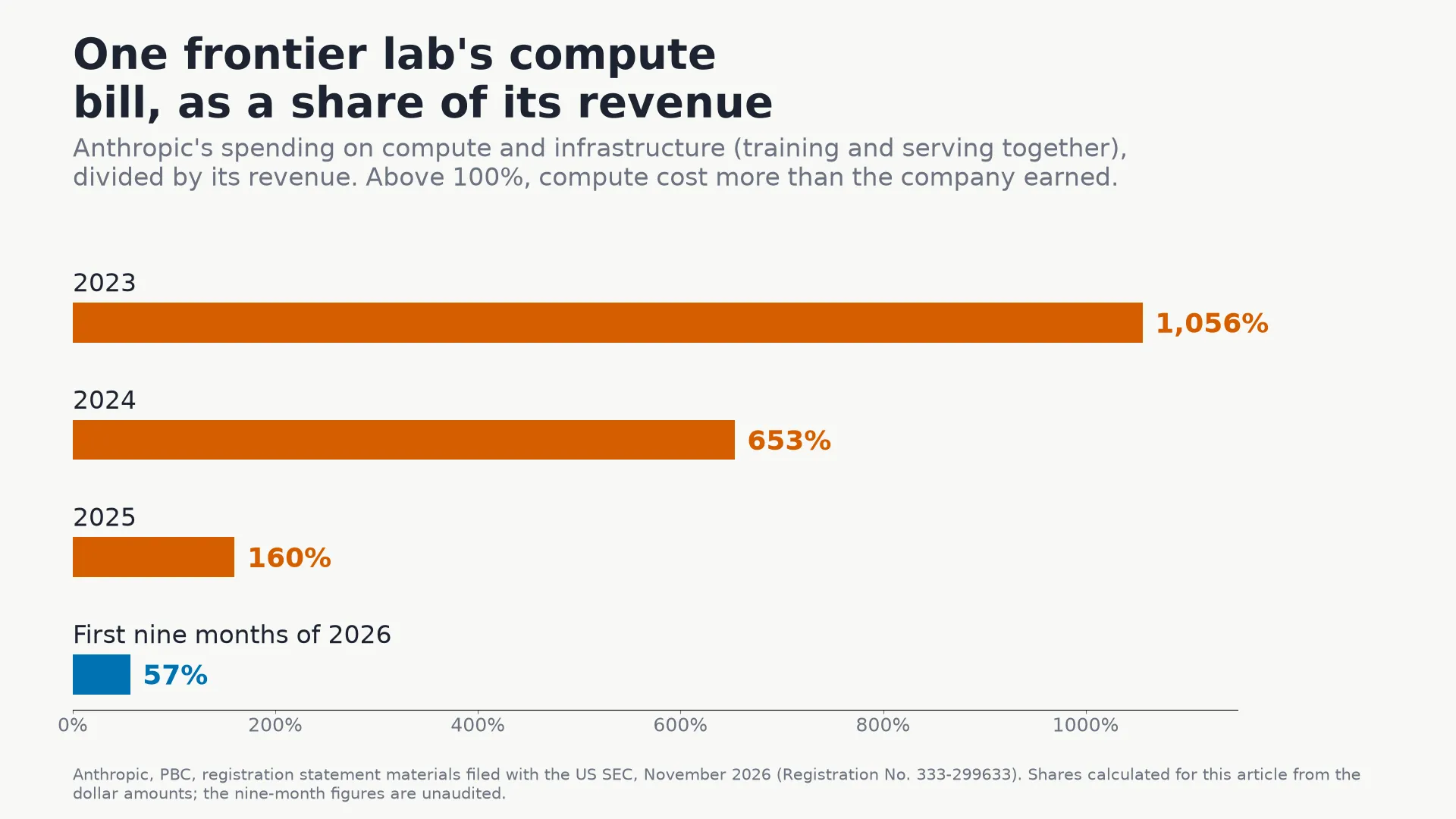
There's a fair question underneath that: are today's prices subsidized? The large labs raised enormous sums and spent heavily to win users, and nobody knows what the market will look like when the competition settles. Will the free lunch end, or will prices keep falling? The best evidence so far is mixed. Anthropic's filing for its public offering shows its total spending on compute, training and serving together, falling from 160% of revenue in 2025 to 57% in the first nine months of 2026.36 That doesn't look like a company selling every token at a loss. It also doesn't tell you what prices will be in five years.
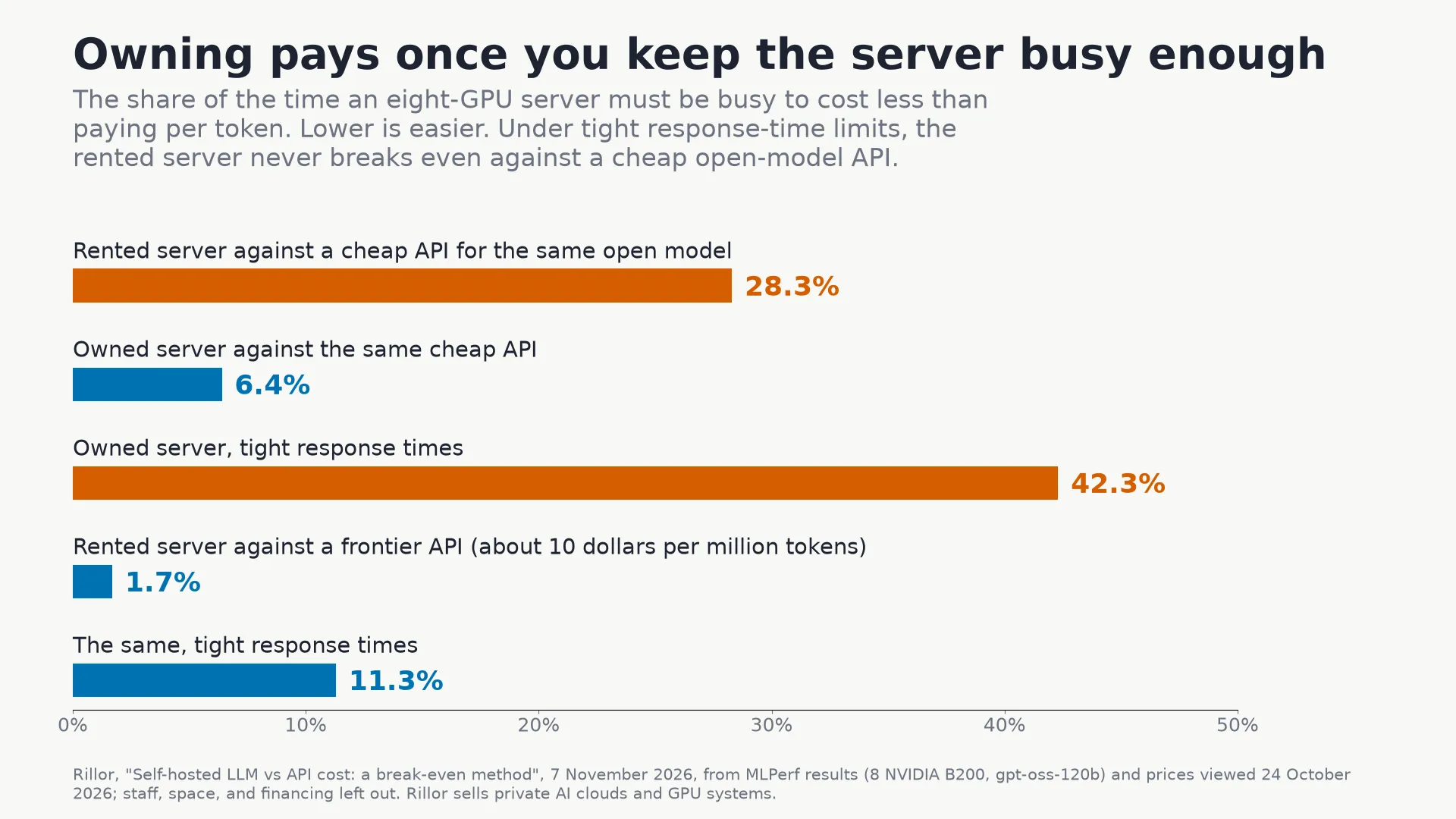
What you can calculate is when owning pays. The logic is the same as renting a car or buying one. If you drive twice a year, renting wins. If you drive every day, owning wins, even though you pay for the car while it sits in the garage. A server is the same: you pay for every hour, busy or idle, so its cost per answer depends on how much of its capacity you actually use. Running your own model costs less than paying per token once you use enough of the capacity you're paying for. One published analysis worked out the break-even for a modern eight-GPU server. Against an inexpensive API for the same open model, a rented server pays off once it is busy between a sixth and a quarter of the time, and an owned one at under a tenth. Against a frontier API, the break-even falls to a few percent. But when every answer must arrive fast, the server can do much less work, and the break-even rises sharply.37
In my experience, a company that buys its own capacity and keeps it busy gets several times more use from each dollar than it does renting by the token. That's my estimate, not a measurement, and it depends entirely on how steadily you use what you buy.
Two costs are easy to forget. The first is latency: a model on your own servers, close to your data, answers faster and on your schedule. The second is people. Running models takes skills most companies don't have yet, and only one in ten companies building with AI trains its own models today.38 That's a reason to get help, not a reason to give up the option.
7. Is lock-in the risk?
I don't think lock-in is the real concern. There are many good models now. You can get strong results from several frontier labs, and from open models you run yourself, which trail the best closed models by about four months.39 Most large companies already run three or more families of models.40 Switching an API address takes minutes.
The real switching costs sit around the model: prompts tuned to one model's quirks, evaluations, agent workflows, and contracts. A study of prompt formatting found that trivial changes, like spacing and punctuation, could swing a model's accuracy by as much as 76 points, and that what works on one model often doesn't on another.41 And a model you fine-tuned on someone else's platform stops working when they retire the base model it's built on.24
So in practice, few companies switch. In one survey, only 11% of companies changed AI vendors in a year; two-thirds upgraded within the provider they already had.42 By late 2026, two labs took 86% of enterprise spending on model APIs.38
That's why I think the better word is leverage. Lock-in is what it costs you to leave. Leverage is what someone can do to you while you stay: change the model, change the price, change the terms, or learn from what you send them. One of the ways others gain leverage over you is by holding your proprietary information, with very little visibility into what's kept or where it goes. Leverage grows with what they hold of yours. When you own your evaluations, your data pipelines, and an open model you can fall back on, it shrinks to the four-month gap.
8. When is renting the right call?
Often. I want to make the case for renting as strongly as I can, because a reader who only hears one side can't decide well.
The frontier is ahead. Closed frontier models lead open ones, and on the hardest reasoning and coding work, that lead matters. Enterprises have noticed: most of what they spend on model APIs goes to the frontier labs.38 Frontier labs are useful for more than their models. What they offer is also a snowball of carefully curated data, compressed into something remarkable.
Things are improving fast. The coding agents I use are far better than they were a year ago, in my estimate ten times better, because of the models and because of the tools built around them. Renting puts that progress in your hands the day it ships, and leaves the risk of aging hardware with someone else.
Most prompts carry nothing sensitive. In one study of 22 million prompts and uploads at large companies, 97% held no sensitive data at all.43 Translation, summaries of public material, and general questions don't need a sovereign model.
Enterprise terms are often enough. For ordinary confidential work, a business contract that bars storing, training, and sharing, and lets you delete, meets the standard a federal court set for confidential discovery.16
Running your own takes work. You take on security, operations, and people. A server you run badly can be less safe than a provider's.
So use the frontier, and use it deliberately. You do want to combine it with your own data in some cases. The point is that you choose when that happens, rather than having your information drawn out of you by default. I wouldn't call it theft. But the lines around consent are blurry, and what you give away can start working against you quickly.
In practice, most companies that think this through end up with a mix. The work that is sensitive, steady, or built on their own experience runs on models they own, on infrastructure they control. The rest goes to the frontier, on business terms, through accounts the company manages, with a clear rule about what may be sent. The mix isn't a compromise. It's what owning your AI looks like: you decide, workload by workload, and you can change your mind, because nobody else holds the switch.
9. Is it one of your top three?
Here's how I'd decide whether any of this belongs on your list.
Peter Drucker made the distinction that matters most. Efficiency is doing things right; effectiveness is doing the right things. "There is surely nothing quite so useless," he wrote, "as doing with great efficiency what should not be done at all."44 Inspired by him, I put it this way: "Leadership is making sure the right things get done." The hard part is the knowledge work of choosing the right things. If you have a thousand things you could be doing, the heavy lift is deciding which three are right. Then you commit to them, do them well, and let some fires burn.
So first, ask whether owning your AI belongs in your top three. Five questions sort any one workload:
- Sensitivity. Does it touch trade secrets, privileged legal work, clients' confidential data, health records, or data a foreign government shouldn't reach?
- Accountability. Will a regulator hold you responsible for how it decides, with logs and explanations?
- Stability. Must it behave the same way for years?
- Experience. Does it get better with your own data, so that learning from your experience is the product?
- Volume. Will you use it steadily enough to pass the break-even point?
Here is how those questions sort three ordinary workloads.
A law firm reviewing contracts. Sensitive, yes: it's clients' confidential material, and privilege is at stake. Accountability, yes: the firm answers to its clients and its bar. Stability matters too, because the firm's lawyers learn how the model behaves and rely on it. Experience, yes: the firm's past negotiations are exactly what would make a model better at its work. Volume is steady. This is a workload to own.
A marketing team drafting social posts about a public launch. Not sensitive: everything in it will be public tomorrow. No regulator will ask how it was written. Stability doesn't matter; a better model next month is welcome. The team's experience helps a little, but a frontier model with good instructions does the job. Rent it, on a business plan.
A retailer forecasting demand for every product in every store. Not especially sensitive, but it's the company's own sales history, and the forecast improves every week the model learns from new results. The volume is enormous and steady, which puts it well past the break-even point. And the best tools for it are tabular and forecasting models, not a chatbot. Own it, even though privacy isn't the reason.
The third case is the one people miss. Owning your AI isn't only about secrets. Often it's simply the right way to build a model that gets better at your business.
If the answers are yes, ownership belongs on your list. If they're no, and it isn't creating a liability under your contracts or the law, then let it wait. Renting is fine. Many companies are better served by finishing one AI project that works than by building infrastructure for projects that don't yet exist. Spending heavily to own the platform for a pilot that fails is exactly the efficient waste Drucker warned about.
If the answers are yes, the next step is to plan, not to buy. Decide which decisions the AI will improve, what data it will learn from, and what return you expect, before you spend. That's what we built Metis to do: to make an AI investment a planned one, with a return you can anticipate, so that you're never blindsided by its cost and you go in with informed consent. When you're the designer of the system, you can aim small and miss small.
And if you'd like someone to think it through with, talk to us. We'll gladly be the friend you bounce ideas off, with no pressure. Maybe that becomes a project. Maybe we just point you to something free that helps. Either way, you'll leave knowing which parts of your AI should be yours.
Notes
- OpenAI, "Privacy Policy" (2026). ↩
- Anthropic, "Updates to Our Consumer Terms and Privacy Policy" (2025); Anthropic, "Privacy Policy" (2026). ↩
- Google, "Gemini API Additional Terms of Service" (2026). ↩
- OpenAI, "Enterprise Privacy at OpenAI" (2026). ↩
- Anthropic, "Commercial Terms of Service" (2025). ↩
- Cyberhaven Labs, 2026 AI Adoption and Risk Report (2026). A vendor's study of 222 companies' data movements. ↩
- OpenAI, "How We're Responding to The New York Times' Data Demands" (2025), on the preservation order of May to September 2025. ↩
- Anthropic, "Data Processing Addendum" (2025), section F, as one example of the standard terms. ↩
- Gurman and Love (2023), quoting and summarizing Samsung's internal memo, which was not published. ↩
- Delétang et al. (2024). ↩
- Morris et al. (2025). ↩
- Carlini et al. (2021). ↩
- Nasr et al. (2023). ↩
- Pappu et al. (2024). The study covers code completion. ↩
- 18 U.S.C. § 1839(3)(A). ↩
- Morgan v. V2X, Inc., No. 1:25-cv-01991 (D. Colo. Mar. 30, 2026). ↩
- United States v. Heppner, 25 Cr. 503 (JSR) (S.D.N.Y. Feb. 17, 2026). The court quotes an earlier decision for the phrase, and reads the provider's consumer privacy policy as of February 2025. ↩
- ABA Standing Committee on Ethics and Professional Responsibility, Formal Opinion 512 (2024). ↩
- 18 U.S.C. § 2713. ↩
- Sénat (2025), hearing of June 10, 2025. My translation of "Non, je ne peux pas le garantir." ↩
- European Commission, Cloud Sovereignty Framework, version 1.2.1 (2025). ↩
- ChapsVision (2026). ↩
- Chen, Zaharia, and Zou (2023). ↩
- OpenAI, "Deprecations" (2026). ↩
- Anthropic, "Model Deprecations" (2026). ↩
- Mitchell (1997), 2. ↩
- Zhao et al. (2024), table 4: an average of 0.688 for the fine-tuned models against 0.661 for GPT-4, across 31 tasks. ↩
- Grinsztajn, Oyallon, and Varoquaux (2022). ↩
- Hollmann et al. (2025). ↩
- Singh et al. (2025). ↩
- Röttger et al. (2024). ↩
- Wu et al. (2023). ↩
- Li et al. (2023), compared with BloombergGPT's published scores; GPT-4 did not lead on every task. ↩
- Cottier et al. (2025). ↩
- Harness (2026). A vendor's survey of 700 engineering and IT leaders. ↩
- Anthropic, PBC (2026), registration statement materials filed with the US Securities and Exchange Commission. The filing gives dollar amounts; the shares are my calculation from them (7,326 of 4,585 million dollars of revenue in 2025; 18,808 of 33,242 million in the nine months to September 30, 2026). The line combines training and serving. ↩
- Rillor (2026). An analyst's published method, from MLPerf results and listed prices; it leaves out staff, space, and financing. Rillor sells private AI clouds and GPU systems. ↩
- Menlo Ventures (2026). A survey of nearly 400 US enterprise decision-makers, fielded by Morning Consult. Menlo Ventures is an investor in Anthropic. ↩
- Edwards and Emberson (2026). ↩
- Wang, Kahl, and Xu (2026). A survey of 100 Global 2000 executives. ↩
- Sclar et al. (2024). ↩
- Menlo Ventures (2025). A survey of 150 technical decision-makers. ↩
- Harmonic Security (2026). A vendor's count of 22,458,240 prompts and uploads in 2025. ↩
- Drucker (1963), as transcribed by Quote Investigator (2021). The paired line "management is doing things right; leadership is doing the right things" is Stephen Covey's, crediting Drucker and Warren Bennis (Quote Investigator 2021). ↩
Bibliography
- ABA Standing Committee on Ethics and Professional Responsibility. 2024. "Formal Opinion 512: Generative Artificial Intelligence Tools." American Bar Association, July 29, 2024. https://www.americanbar.org/content/dam/aba/administrative/professional_responsibility/ethics-opinions/aba-formal-opinion-512.pdf.
- Anthropic. 2025. "Updates to Our Consumer Terms and Privacy Policy." August 28, 2025. https://www.anthropic.com/news/updates-to-our-consumer-terms.
- Anthropic. 2025. "Commercial Terms of Service." Effective June 17, 2025. https://www.anthropic.com/legal/commercial-terms.
- Anthropic. 2025. "Data Processing Addendum." Effective February 24, 2025. https://www.anthropic.com/legal/data-processing-addendum.
- Anthropic. 2026. "Privacy Policy." https://www.anthropic.com/legal/privacy.
- Anthropic. 2026. "Model Deprecations." Claude Platform Documentation. https://platform.claude.com/docs/en/about-claude/model-deprecations.
- Anthropic, PBC. 2026. Registration statement materials (Registration No. 333-299633). US Securities and Exchange Commission, November 2026. https://www.sec.gov/Archives/edgar/data/2130357/000162828026072952/anthropicpbc-fwpukmaterials.htm.
- Carlini, Nicholas, Florian Tramèr, Eric Wallace, Matthew Jagielski, Ariel Herbert-Voss, Katherine Lee, Adam Roberts, et al. 2021. "Extracting Training Data from Large Language Models." In Proceedings of the 30th USENIX Security Symposium. https://arxiv.org/abs/2012.07805.
- ChapsVision. 2026. "ChapsVision Chosen by France to Deploy Argonos for OTDH Project." Press release, June 16, 2026. https://www.chapsvision.com/press-release/chapsvision-chosen-by-france-to-deploy-Argonos-for-otdh-project/.
- Chen, Lingjiao, Matei Zaharia, and James Zou. 2023. "How Is ChatGPT's Behavior Changing over Time?" arXiv:2307.09009. https://arxiv.org/abs/2307.09009.
- Cottier, Ben, Ben Snodin, David Owen, and Tom Adamczewski. 2025. "LLM Inference Prices Have Fallen Rapidly but Unequally Across Tasks." Epoch AI, March 12, 2025. https://epoch.ai/data-insights/llm-inference-price-trends.
- Cyberhaven Labs. 2026. 2026 AI Adoption and Risk Report. Cyberhaven. https://info.cyberhaven.com/hubfs/Webflow_Resources/Cyberhaven-AI-Risk-Report-2026.pdf.
- Delétang, Grégoire, Anian Ruoss, Paul-Ambroise Duquenne, Elliot Catt, Tim Genewein, Christopher Mattern, Jordi Grau-Moya, et al. 2024. "Language Modeling Is Compression." In International Conference on Learning Representations. https://arxiv.org/abs/2309.10668.
- Drucker, Peter F. 1963. "Managing for Business Effectiveness." Harvard Business Review 41 (3): 53–60. https://hbr.org/1963/05/managing-for-business-effectiveness.
- Edwards, Jack, and Luke Emberson. 2026. "Open Models Lag State-of-the-Art Closed Models by 4 Months." Epoch AI, May 29, 2026. https://epoch.ai/data-insights/open-closed-eci-gap.
- European Commission. 2025. Cloud Sovereignty Framework, version 1.2.1. October 2025. https://commission.europa.eu/document/download/09579818-64a6-4dd5-9577-446ab6219113_en?filename=Cloud-Sovereignty-Framework.pdf.
- Google. 2026. "Gemini API Additional Terms of Service." https://aistudio.google.com/docs/terms.
- Grinsztajn, Léo, Edouard Oyallon, and Gaël Varoquaux. 2022. "Why Do Tree-Based Models Still Outperform Deep Learning on Typical Tabular Data?" In Advances in Neural Information Processing Systems 35. https://papers.neurips.cc/paper_files/paper/2022/hash/0378c7692da36807bdec87ab043cdadc-Abstract-Datasets_and_Benchmarks.html.
- Gurman, Mark, and Julia Love. 2023. "Samsung Bans Generative AI Use by Staff After ChatGPT Data Leak." Bloomberg News, May 2, 2023. https://www.bloomberg.com/news/articles/2023-05-02/samsung-bans-chatgpt-and-other-generative-ai-use-by-staff-after-leak.
- Harmonic Security. 2026. "What 22 Million Enterprise AI Prompts Reveal About Shadow AI in 2025." January 15, 2026. https://www.harmonic.security/resources/what-22-million-enterprise-ai-prompts-reveal-about-shadow-ai-in-2025.
- Harness. 2026. 2026 State of AI in FinOps. https://www.harness.io/state-of-ai-in-finops-2026.
- Hollmann, Noah, Samuel Müller, Lennart Purucker, Arjun Krishnakumar, Max Körfer, Shi Bin Hoo, Robin Tibor Schirrmeister, and Frank Hutter. 2025. "Accurate Predictions on Small Data with a Tabular Foundation Model." Nature 637: 319–326. https://www.nature.com/articles/s41586-024-08328-6.
- Li, Xianzhi, Xiaodan Zhu, Zhiqiang Ma, Xiaomo Liu, and Sameena Shah. 2023. "Are ChatGPT and GPT-4 General-Purpose Solvers for Financial Text Analytics? A Study on Several Typical Tasks." arXiv:2305.05862. https://arxiv.org/abs/2305.05862.
- Menlo Ventures. 2025. "2025 Mid-Year LLM Market Update." July 31, 2025. https://menlovc.com/perspective/2025-mid-year-llm-market-update/.
- Menlo Ventures. 2026. 2026: The State of Enterprise AI. November 3, 2026. https://menlovc.com/wp-content/uploads/2026/11/menlo_ventures_enterprise_ai_report-2026-110326.pdf.
- Mitchell, Tom M. 1997. Machine Learning. New York: McGraw-Hill.
- Morgan v. V2X, Inc. 2026. No. 1:25-cv-01991-SKC-MDB, ECF No. 65 (D. Colo. March 30, 2026). https://www.govinfo.gov/content/pkg/USCOURTS-cod-1_25-cv-01991/pdf/USCOURTS-cod-1_25-cv-01991-0.pdf.
- Morris, John X., Chawin Sitawarin, Chuan Guo, Narine Kokhlikyan, G. Edward Suh, Alexander M. Rush, Kamalika Chaudhuri, and Saeed Mahloujifar. 2025. "How Much Do Language Models Memorize?" arXiv:2505.24832. https://arxiv.org/abs/2505.24832.
- Nasr, Milad, Nicholas Carlini, Jonathan Hayase, Matthew Jagielski, A. Feder Cooper, Daphne Ippolito, Christopher A. Choquette-Choo, Eric Wallace, Florian Tramèr, and Katherine Lee. 2023. "Scalable Extraction of Training Data from (Production) Language Models." arXiv:2311.17035. https://arxiv.org/abs/2311.17035.
- OpenAI. 2025. "How We're Responding to The New York Times' Data Demands in Order to Protect User Privacy." Updated September 26, 2025. https://openai.com/index/response-to-nyt-data-demands/.
- OpenAI. 2026. "Deprecations." OpenAI API documentation. https://platform.openai.com/docs/deprecations/.
- OpenAI. 2026. "Enterprise Privacy at OpenAI." https://openai.com/enterprise-privacy/.
- OpenAI. 2026. "Privacy Policy." https://openai.com/policies/row-privacy-policy/.
- Pappu, Aneesh, Billy Porter, Ilia Shumailov, and Jamie Hayes. 2024. "Measuring Memorization in RLHF for Code Completion." arXiv:2406.11715. https://arxiv.org/abs/2406.11715.
- Quote Investigator. 2021. "Efficiency Is Concerned With Doing Things Right. Effectiveness Is Doing the Right Things." April 9, 2021. https://quoteinvestigator.com/2021/04/09/doing-right/.
- Rillor. 2026. "Self-Hosted LLM vs API Cost: A Break-Even Method." November 7, 2026. https://rillor.com/insights/self-hosted-llm-vs-api-cost/report.
- Röttger, Paul, Hannah Rose Kirk, Bertie Vidgen, Giuseppe Attanasio, Federico Bianchi, and Dirk Hovy. 2024. "XSTest: A Test Suite for Identifying Exaggerated Safety Behaviours in Large Language Models." In Proceedings of NAACL 2024. https://arxiv.org/abs/2308.01263.
- Sclar, Melanie, Yejin Choi, Yulia Tsvetkov, and Alane Suhr. 2024. "Quantifying Language Models' Sensitivity to Spurious Features in Prompt Design." In International Conference on Learning Representations. https://arxiv.org/abs/2310.11324.
- Sénat (France). 2025. Commission d'enquête sur la commande publique, hearing of Anton Carniaux and Pierre Lagarde (Microsoft France), June 10, 2025. https://www.senat.fr/compte-rendu-commissions/20250609/ce_commande_publique.html.
- Singh, Shivalika, Yiyang Nan, Alex Wang, Daniel D'Souza, Sayash Kapoor, Ahmet Üstün, Sanmi Koyejo, et al. 2025. "The Leaderboard Illusion." arXiv:2504.20879. https://arxiv.org/abs/2504.20879.
- United States v. Heppner. 2026. No. 25 Cr. 503 (JSR), ECF No. 27 (S.D.N.Y. February 17, 2026). https://storage.courtlistener.com/recap/gov.uscourts.nysd.652137/gov.uscourts.nysd.652137.27.0.pdf.
- US Code. 18 U.S.C. § 1839 (Defend Trade Secrets Act, definitions). https://uscode.house.gov/view.xhtml?req=granuleid:USC-prelim-title18-section1839&num=0&edition=prelim.
- US Code. 18 U.S.C. § 2713 (CLOUD Act). https://uscode.house.gov/view.xhtml?req=granuleid:USC-prelim-title18-section2713&num=0&edition=prelim.
- Wang, Sarah, Justin Kahl, and Shangda Xu. 2026. "Leaders, Gainers and Unexpected Winners in the Enterprise AI Arms Race." Andreessen Horowitz, January 30, 2026. https://a16z.com/leaders-gainers-and-unexpected-winners-in-the-enterprise-ai-arms-race/.
- Wu, Shijie, Ozan Irsoy, Steven Lu, Vadim Dabravolski, Mark Dredze, Sebastian Gehrmann, Prabhanjan Kambadur, David Rosenberg, and Gideon Mann. 2023. "BloombergGPT: A Large Language Model for Finance." arXiv:2303.17564. https://arxiv.org/abs/2303.17564.
- Zhao, Justin, Timothy Wang, Wael Abid, Geoffrey Angus, Arnav Garg, Jeffery Kinnison, Alex Sherstinsky, Piero Molino, Travis Addair, and Devvret Rishi. 2024. "LoRA Land: 310 Fine-Tuned LLMs That Rival GPT-4, A Technical Report." arXiv:2405.00732. https://arxiv.org/abs/2405.00732.