
Would your business run without you?
Steve Sperandeo ·
Watch the five-minute video
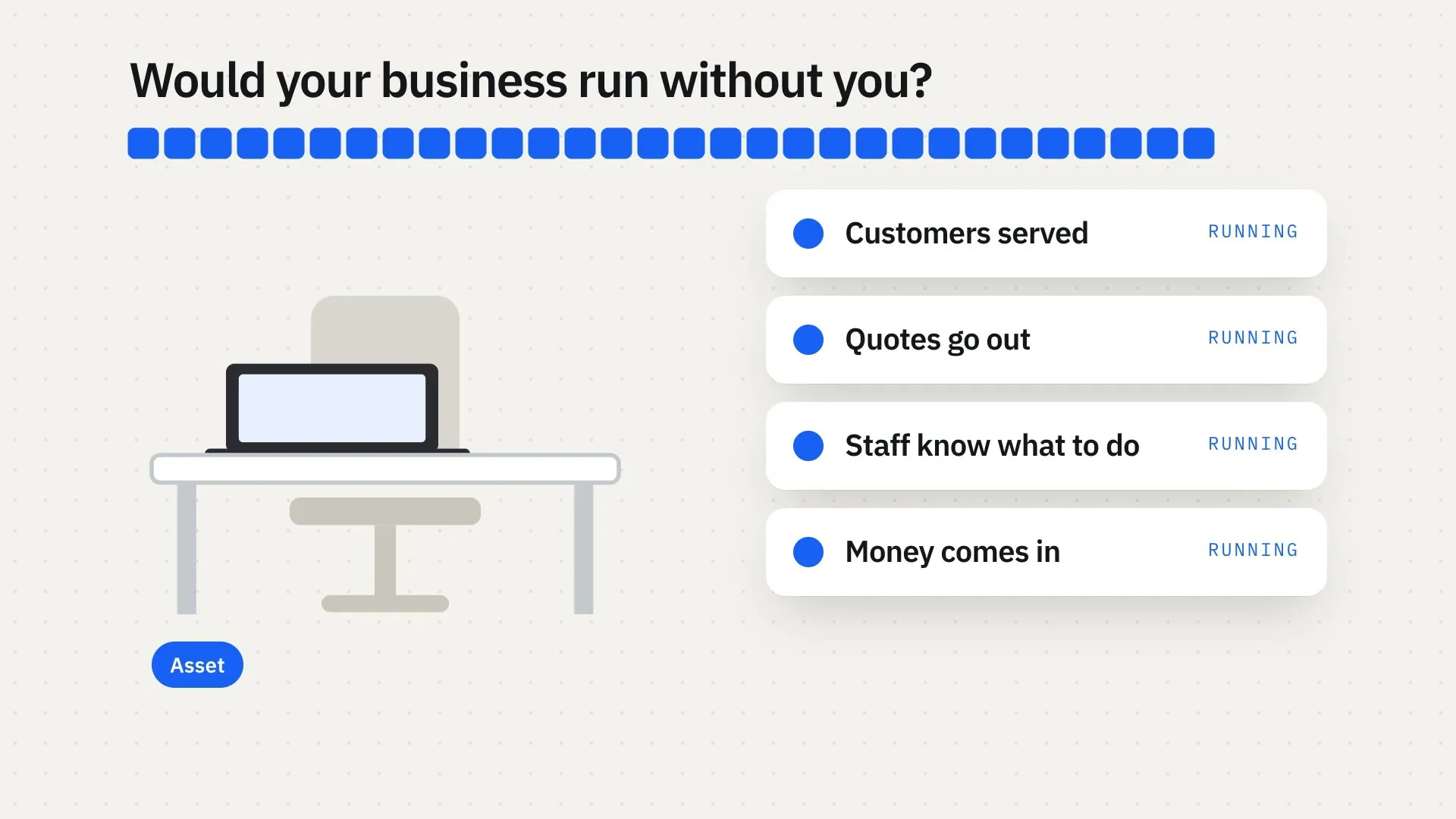
If you left your business for a month, would it keep running? Would the customers be served, the quotes go out, the staff know what to do, and the money come in? If it would, you own an asset. If it wouldn't, you own a job, and a demanding one, because it can't go on without you.
A month away is the test I'd give any owner. It's simple, and it's honest. Most owners already know their answer, and they don't like it.
Owners hold up their businesses, and everyone who prices one knows it
The cleanest evidence comes from the worst kind of absence. Two economists followed nearly 1,500 young Norwegian firms whose founder died, and found "large and sustained negative effects on growth and profitability." For the smallest firms, the damage came "mainly via firm survival": many simply didn't make it.1
The people who put a price on businesses have known this for a long time. The IRS told valuers in 1959 that "the loss of the manager of a so-called 'one-man' business may have a depressing effect upon the value of the stock of such business, particularly if there is a lack of trained personnel capable of succeeding to the management of the enterprise."2 Lenders ask the same thing. Since October 2026, a US lender financing the purchase of a small business under the government's main loan program must describe "how the daily operations will be managed if the principals are not there on a daily basis."3
Buyers ask the question most of all. They are buying what the business does without the person who built it. Anything that leaves with the seller isn't for sale.
Most small businesses don't change hands. They close
The question matters more now than ever. By one estimate, about six million small US businesses will exit ownership by 2035. Of those that exited in 2022, the same researchers estimate, 92% closed, 5% were sold, and 3% passed to new owners, often family.4 In Canada, 63% of owners say they plan to exit within ten years, and 6% have a formal written succession plan.5
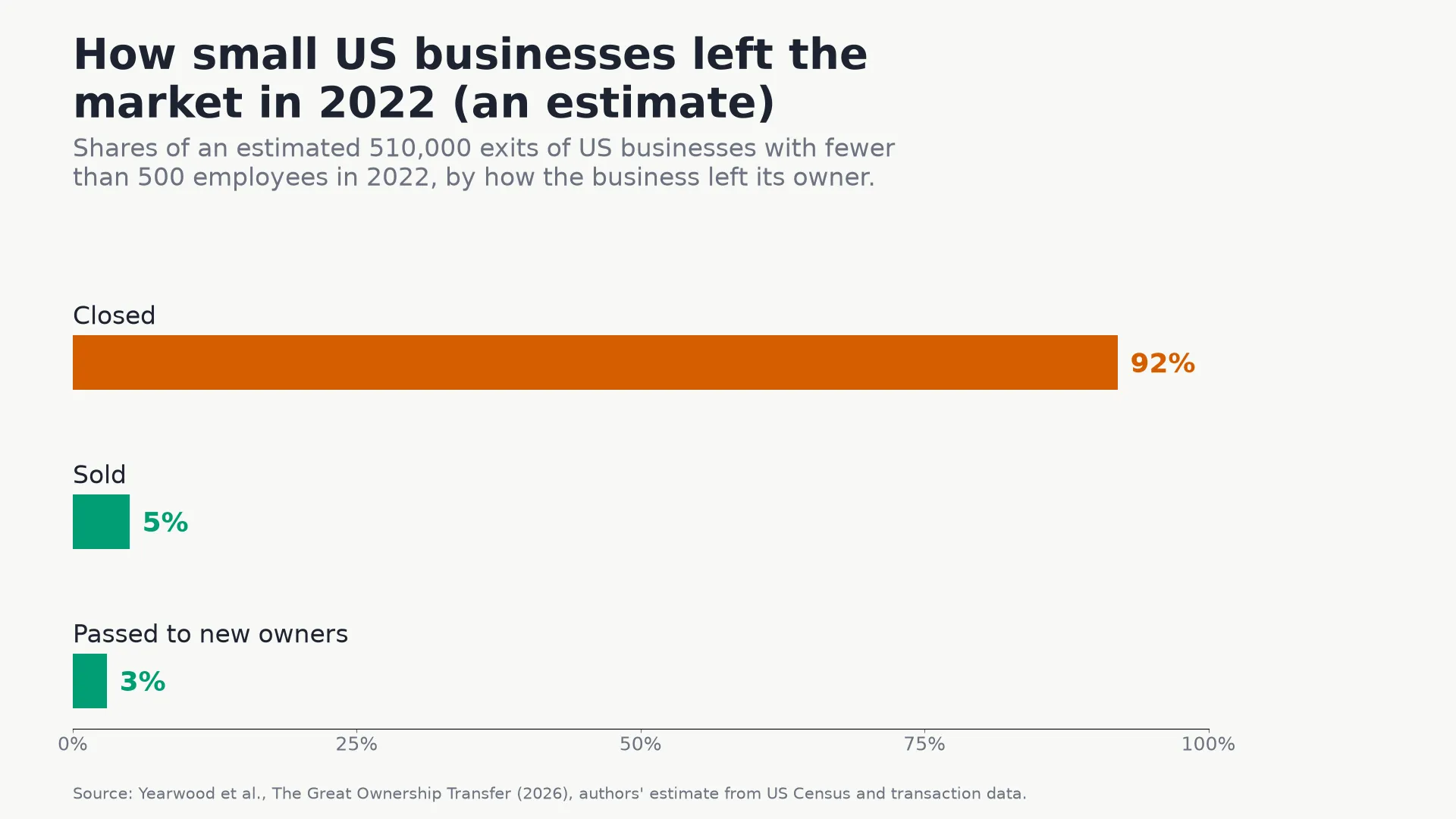
A closure isn't always a failure. Some owners close because the business was always a good job, and the job is done. But many of those businesses had customers, staff, and years of know-how that someone would have paid for, if any of it had existed outside the owner's head.
Build it to sell, even if you keep it
Should an owner who never means to sell bother? I think so. If a business is built so that it can be sold, you might keep it for the rest of your life, but it's easier to run, because it's a systematized business. And it's something of real value for your family.
There's also the question of timing, which no owner controls. Canada's prime minister, Mark Carney, made the point about a country's finances: you'd better have your house in order, because by the time you need to, it's too late.6 So it is with a business. The buyer, the illness, or the offer arrives on its own schedule.
Michael Gerber made the case thirty years ago. He told owners to work on their business, not in it, and held up the business he wanted them to build: "A systems-dependent business, not a people-dependent business. A business that could work without him."7
The evidence since then is encouraging and honest about its limits. Across more than 20,000 small firms in seven countries, better business practices go with much higher productivity, though that is a correlation.8 In a controlled trial in Mexico, consulting raised productivity in the first year and employment years later;9 in another, in Ghana, it raised neither profits nor habits that lasted.10 Systems help. They take time to show it, and they only help if they're used.
What's in your head, and why the usual advice falls short
What would a buyer, or a new manager, need from your head? All the processes: how a job is quoted, how a complaint is handled, what you check before an invoice goes out, which supplier to call when the usual one can't deliver. And all the relationships: who the best customers are, what each one expects, and who to call when something goes wrong. Michael Polanyi wrote that "we can know more than we can tell."11 An owner knows a great deal more than they have ever told anyone.
The usual advice is sound. Write a manual. Train a second-in-command. Hire a broker years before you sell. Buyers already keep sellers on to pass on what they know: in one large study of search funds, sellers stayed engaged for six months after the sale, up from four.12 The trouble with the advice is simple: it takes time to do it, and time is the one thing a business that depends on its owner never has.
Structure is the steel frame
A system is a set of constraints. That's what structure gives a business: a spine, a skeleton, the steel frame that holds up an eight-story building. Donella Meadows defined a system as "an interconnected set of elements that is coherently organized in a way that achieves something."13 Without that frame, the owner is holding up the building.
Most businesses already have the material for the frame. It's in their conversations and their documents: calls with customers, meetings with staff, emails, quotes, notes, and files strewn about here and there. That's all unstructured data. In a business where the conversations are recorded and transcribed, AI can now take that material and give it structure: the processes as they're really done, the commitments made, the decisions and their reasons, written down as records the team can follow. A person still checks each one. The evidence on turning conversations into records is real and modest: in a randomized trial, doctors given an AI scribe spent about twenty minutes less on their notes each day, and reported less exhaustion.14 That is a long way from writing a business's procedures for it, but it points the same way.
Once the frame is in place, the business is easier to hire for, easier to train people in, and easier to keep consistent. Then you can sprinkle in AI agents to do some of the work inside it, because now there's something for them to work within.
The first step
Run the test. Pick a month, or start with a week, and write down everything that would stop without you. That list is your business's to-do list.
If you'd like help with it, give us a call. With Orama Business, you enroll in our program for six hundred and twenty-five dollars a week, cancel any week. We meet with you and ask pointed questions, then take what your business already has, its conversations and its documents, and give it structure. Within a few days you can have a working system that you log into, start using, adapt, and give us feedback on.
Whichever way you do it, the question doesn't change. Would your business run without you? The best time to make the answer yes is before anyone asks.
Notes
- Becker and Hvide (2022). The study follows privately owned Norwegian startups in which a founder died. ↩
- Internal Revenue Service (1959), Revenue Ruling 59-60, section 4.02(b). ↩
- US Small Business Administration (2026), SOP 50 10 8.1, Appendix 15. The rule is effective for loans numbered on or after 1 October 2026. ↩
- Yearwood et al. (2026). Both figures are the authors' estimates from US Census and transaction data; the 2022 shares are of an estimated 510,000 exits of businesses with fewer than 500 employees. ↩
- Cruz and Bomal (2026). An online survey of 1,731 Canadian business owners, May to June 2026. ↩
- A paraphrase. In his remarks of 22 August 2026, answering a question about markets and Canada's public finances, Carney (2026) said, "if you don't have your house in order, it's too late." ↩
- Gerber (1995). ↩
- McKenzie and Woodruff (2015). A one-standard-deviation higher practice score is associated with about 35 percent higher labor productivity before controls, and about 22 to 27 percent after them. It is a correlation. ↩
- Bruhn, Karlan, and Schoar (2018). A randomized trial of 432 firms in Puebla, Mexico. The published paper reports "a persistent large increase (about 50 percent) in the number of employees and total wage bill even 5 years after the program." ↩
- Karlan, Knight, and Udry (2015). A randomized trial of 160 tailors in Accra, Ghana. ↩
- Polanyi (1966), 4. ↩
- Stanford Graduate School of Business (2024). ↩
- Meadows (2008), 11. ↩
- Afshar et al. (2025). A stepped-wedge randomized trial of 66 practitioners; time on notes fell by 0.36 hours a day. ↩
Bibliography
- Afshar, Majid, et al. 2025. "A Pragmatic Randomized Controlled Trial of Ambient Artificial Intelligence to Improve Health Practitioner Well-Being." NEJM AI 2 (12). https://ai.nejm.org/doi/full/10.1056/AIoa2500945.
- Becker, Sascha O., and Hans K. Hvide. 2022. "Entrepreneur Death and Startup Performance." Review of Finance 26 (1): 163–185. https://academic.oup.com/rof/article-abstract/26/1/163/6281083.
- Bruhn, Miriam, Dean Karlan, and Antoinette Schoar. 2018. "The Impact of Consulting Services on Small and Medium Enterprises: Evidence from a Randomized Trial in Mexico." Journal of Political Economy 126 (2). https://doi.org/10.1086/696154.
- Carney, Mark. 2026. "Statement and Q&A on Canada-U.S. Trade Negotiations." Ottawa, 22 August 2026. Transcript, American Rhetoric. https://www.americanrhetoric.com/speeches/markcarney-canada-us-failed-trade-deal.htm.
- Cruz, Marvin, and Laure-Anne Bomal. 2026. Passing the Torch. Canadian Federation of Independent Business. https://www.cfib-fcei.ca/hubfs/research/reports/2026/succession/2026-10-20-Succession-2026-EN_final.pdf.
- Gerber, Michael E. 1995. The E-Myth Revisited: Why Most Small Businesses Don't Work and What to Do About It. New York: HarperBusiness.
- Internal Revenue Service. 1959. Revenue Ruling 59-60. 1959-1 C.B. 237.
- Karlan, Dean, Ryan Knight, and Christopher Udry. 2015. "Consulting and Capital Experiments with Microenterprise Tailors in Ghana." Journal of Economic Behavior and Organization 118: 281–302.
- McKenzie, David, and Christopher Woodruff. 2015. "Business Practices in Small Firms in Developing Countries." Policy Research Working Paper 7405. Washington, DC: World Bank. https://documents1.worldbank.org/curated/en/812381467999130334/pdf/WPS7405.pdf. Published in Management Science 63 (9), 2017, https://doi.org/10.1287/mnsc.2016.2492.
- Meadows, Donella H. 2008. Thinking in Systems: A Primer. White River Junction, VT: Chelsea Green.
- Polanyi, Michael. 1966. The Tacit Dimension. Garden City, NY: Doubleday.
- Stanford Graduate School of Business. 2024. "2024 Search Fund Study: Selected Observations." Case E-870.
- US Small Business Administration. 2026. SOP 50 10 8.1: Lender and Development Company Loan Programs. Effective 1 October 2026. https://legacy.sba.gov/document/sop-50-10-lender-development-company-loan-programs.
- Yearwood, Stewart, et al. 2026. The Great Ownership Transfer: A New Era of Business Stewardship. McKinsey Institute for Economic Mobility. https://www.mckinsey.com/institute-for-economic-mobility/our-insights/the-great-ownership-transfer-a-new-era-of-business-stewardship.