
Watch the twenty-three-minute video
This is a walk through Orama Lake in ten chapters, from the map down to the engine and back up to the prompt that runs it.
Contents
- One stack, research to production
- zetta, the engine
- Workspaces and your data
- Training on your own data
- AI Projects and pipelines
- Agents
- Apps and identity
- liquid: source control, builds, packages, and deploys in one program
- Infrastructure as software
- Run it from Claude Code
Appendix: everything Orama Lake replaces, and how far
One stack, research to production
Anyone who has put AI into a real production environment knows how it goes. The demo takes an afternoon. Then the real work starts.
The data the model needs can't leave the building. Security asks where every record goes, and deserves an answer. The model needs somewhere to run, and what it reads needs somewhere to live. There has to be search, sign-in, a place for the secrets, a way to build it, and a way to deploy it. Each piece comes from somewhere different, and somebody has to make them work together and keep them working.
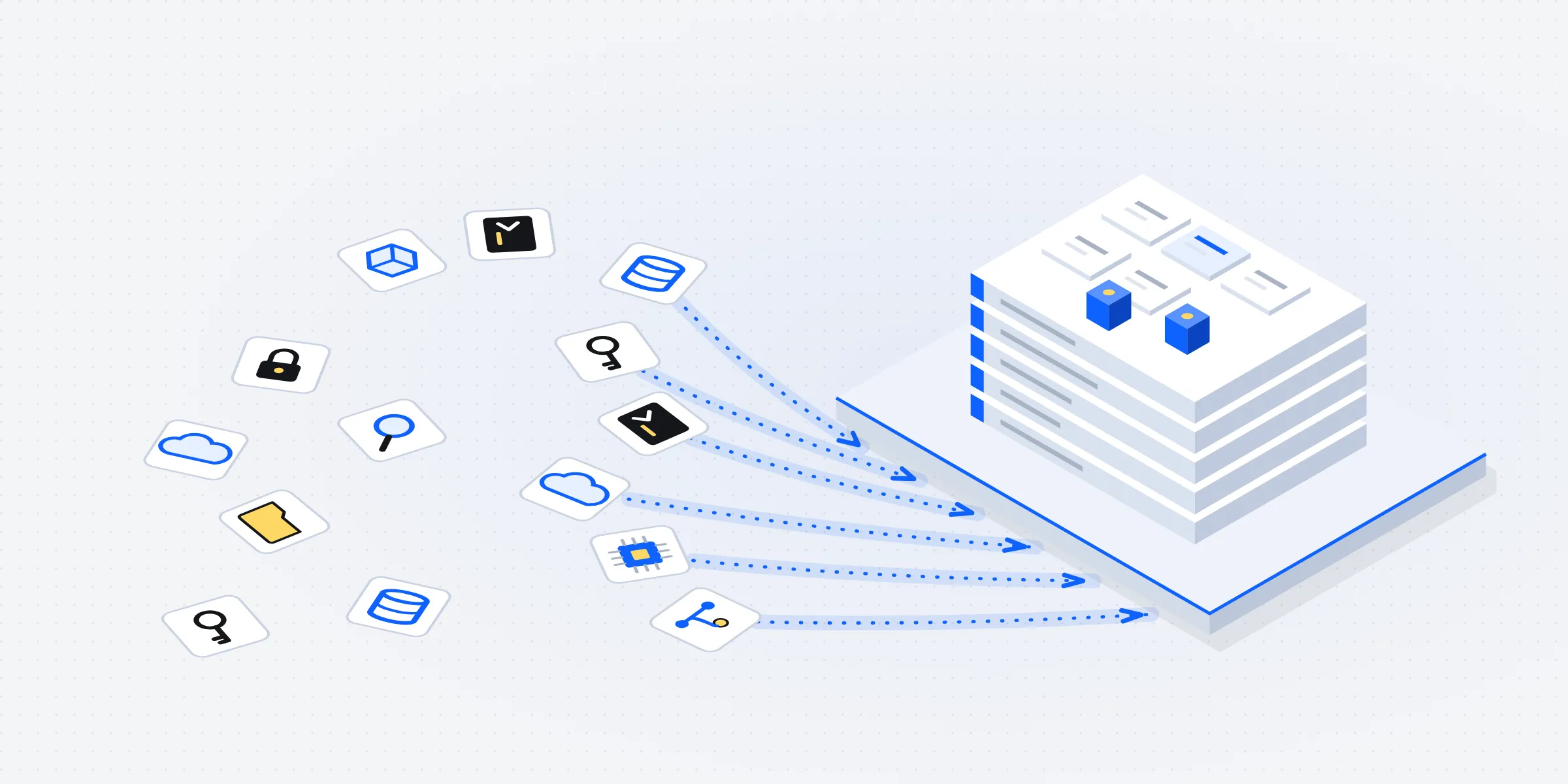
Orama Lake is what you get when those pieces are built as one stack, with one button to start it. It is the first system that combines everything a production-grade AI deployment needs, at every phase: designing it, training it, packaging it, shipping it, and operating it, from monitoring to DevOps, TechOps, and MLOps. It's written almost entirely in modern C++, C++26, for portability, distributed algorithms, and support for accelerators and devices. It runs on-prem, in a private or public cloud, or air-gapped if you need it, from supercomputers to embedded devices: an empty zetta node takes 6 MB of resident memory, and a custom build can go smaller. It runs on every cloud platform and every CPU architecture, and on Linux, macOS, and Windows. On GPUs and other accelerators it runs on custom kernels, and we can write them for any architecture on request. That is possible because every algorithm in it was written from scratch, to run on all of them, and distributed across many machines. And it is the same code that runs lake.live.1
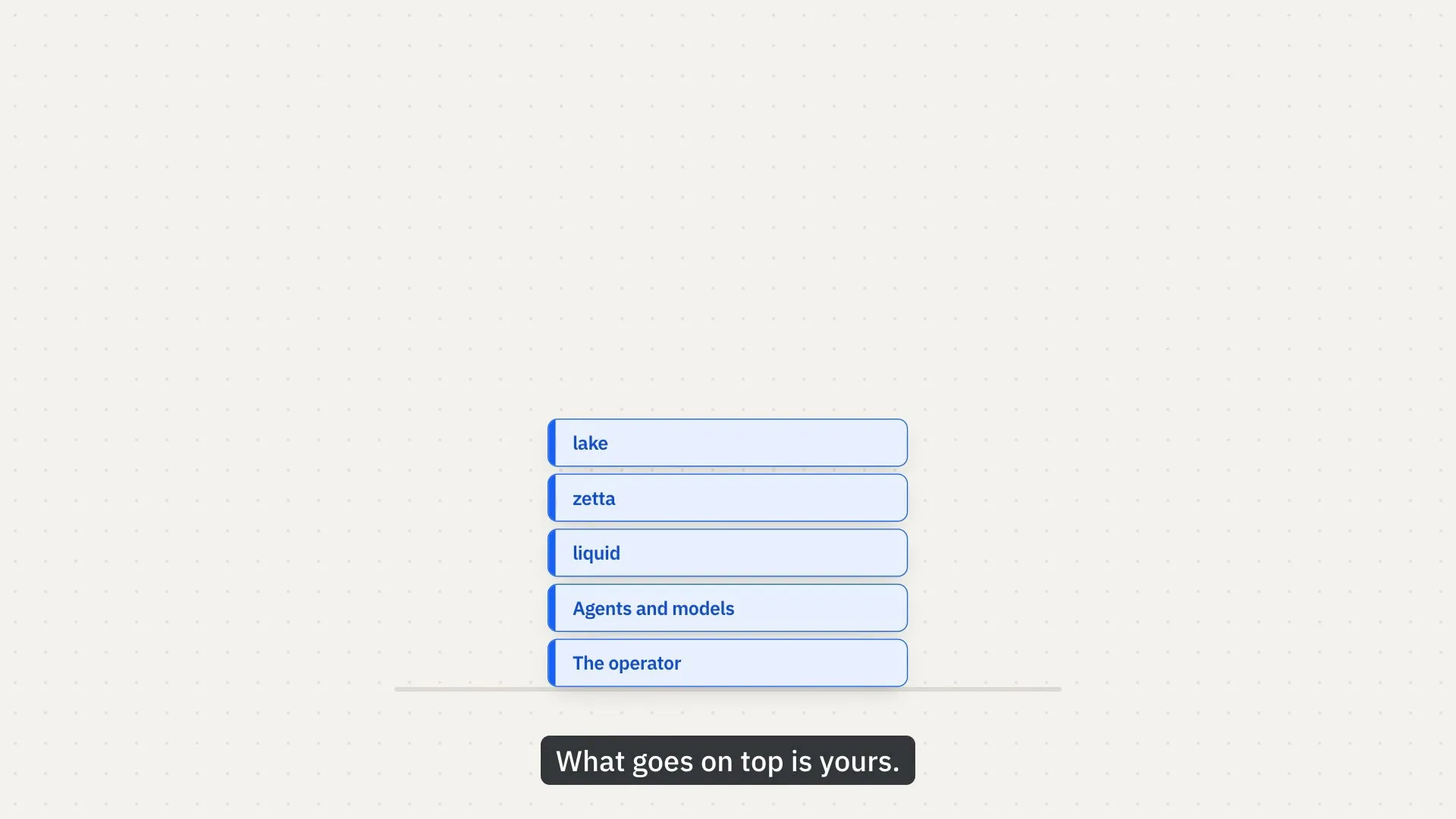
The map has five parts:
- lake is where you work. It holds your workspaces, AI Projects, agents, apps, repositories, drives, search, sign-in, secrets, and a container registry.
- zetta is the engine underneath: a distributed database engine, a cluster of equal peers with no leader. It stores and queries your data, searches it, runs workflows on it, trains machine-learning models on it across many machines, serves their predictions, and explains every one they make.
- liquid is differential source control, builds, packages, and deploys in one program.
- The operator runs all of it on Kubernetes as infrastructure as software, and creates the clusters, DNS records, and buckets a project needs.
- The agents and models: the agent that builds agents, the one that builds apps, the one you ask questions, and the models they run on.
All of it sits behind one API. Every capability is defined once, in one registry, and served three ways: as REST, as an OpenAPI 3.1 document, and as tools over MCP. The web app calls only that API. So a person, a script, and an agent all use the same thing, with the same permissions and the same audit.2
Because the parts are one system, the distance between them shrinks. Experiment tracking, a streaming agent substrate, and differential source control, builds, and deploys are one system, so what works in an experiment in the morning can be in front of people by the evening.
A team shipping AI usually buys each of these parts separately: a cloud warehouse, a machine-learning platform, a hosted model API, an agent builder, version control and a code host, a build service, an app host, a tunnel service, a secrets vault, and an identity provider. Orama Lake puts them in one stack, on your own hardware, under one sign-in and one API. Among the best known it replaces are SageMaker and Vertex AI, Hugging Face, the agent builders and much of the OpenAI, Anthropic, and Gemini APIs; Confluent and Kafka, Supabase and Neon, Elastic and Algolia, Pinecone, Airflow, dbt, Fivetran, n8n, and Zapier; Git, GitHub, GitHub Actions, and Docker Hub; Railway, Heroku, Vercel, Terraform, and Datadog; ngrok and Tailscale; Okta, Auth0, and HashiCorp Vault; and S3, Dropbox, and Google Drive. The whole list, with how far Orama Lake goes for each, is in the appendix.
That makes Orama Lake the open-source, MIT-licensed replacement for Palantir, Databricks, and Snowflake. Each of them is excellent at what it does. The difference is where it runs and who owns it: Orama Lake runs on your hardware or in your own cloud account, and its code is yours, so your data, your models, and your returns stay with you. The comparison, capability by capability, is on orama.com/capability-matrix.
Orama Lake also goes beyond those platforms, because it is AI that helps you easily build custom AI. You describe the agent, the app, or the pipeline you want, and Lake's own agents build it, on your data, with the same tools you would use. You use AI to create and ship AI.
zetta, the engine
Everything in Orama Lake rests on zetta, so I'll start there.
zetta is one statically linked C++26 binary with no runtime services to provision. It runs headless on a server, or headed with a desktop UI. Every node in a cluster is an equal peer. There is no leader and no election. Nodes join with a join token and talk to each other over mutual TLS. All of the cluster's state is one CRDT document that every node converges on, so any node can take a write and every node ends up in the same place.3
Storage is replicated: databases, tables and rows, large objects, a keyed record store, and an object store. Every write replicates to every node, and large bodies move peer to peer, checked by SHA-256.
On top of that sits a dialect-neutral SQL engine. Tables are partitioned, and a query scans each partition on the node that owns it. The principle runs through the whole engine: work runs next to the data it reads, and the partial results are combined across nodes. The unit of execution is the cluster, not the node, so the resource being spent is the combined CPU, memory, disk, and network bandwidth of every machine.4 The same holds for distributed dataframes, which run on a work-stealing scheduler behind one ComputeDevice interface: the CPU always, and an accelerator when there is one.
zetta is coroutine-based from the ground up. Async work is an awaitable, and concurrency is a matter of composing awaitables, so a waiting operation costs nothing, a single node can saturate its own link, and the cluster can saturate all of them.
Search is built in. Full-text indexes live per partition and are searched by scatter-gather, then ranked, over data and documents alike. A search index over a dataset's text columns can be published and called from outside, like a model.
And zetta has a message bus, built with agents as its main user. Every event carries an envelope much like an email's: who it is from, the chain of senders, to, cc, bcc, reply-to, and a correlation id. Every addressable thing gets an inbox. Topics are created at runtime, subscriptions choose where they start and whether they share work as a group, and delivery can be at least once or exactly once, with claims, priority levels that age, dead letters, and spilling to disk when memory runs short. Delivery options can be set on a topic, a subscription, or a single message, always within what governance allows.5
Access is governed at every level: key-scoped and role-based access, column masking and row security, a sealed identity root, and an audit trail of every call. Every operation also records its intent, plan, timing, and result shape as spans you can read back as system.* views.
Workspaces and your data
A workspace is one team's place in Orama Lake, and each workspace has its own zetta.
That one design choice does a lot of work. Everything that belongs to a workspace lives in that workspace's engine: its data, its files, its credentials, its metrics, its logs, and its history. It is sealed with the workspace's own key, apart from every other workspace and every other customer. lake's own database holds only what multitenancy needs: accounts, workspaces, memberships, grants, and which engine serves which workspace. A person can have many workspaces, for example one each for dev, staging, and prod, and each one is a separate engine.6
You bring data in three ways. Upload a file and it becomes a dataset. Connect a database you already run, and the workspace reads from it; the connection's password reaches the workspace only, and is never shown again. Or have Lake run the database for you: Postgres, Kafka, and the other open-source databases and streams it offers, or zetta itself, as services in your own account, with the storage they need.
Files live in drives. A drive can hold workspace files, encrypted with the workspace's key; a repository with full history, where every upload, move, and delete is a change you can compare and restore; shortcuts to things that live elsewhere; or one of the workspace's buckets, browsed where it is. Drives sync to a folder on your machine, through liquid, and folders can be shared with expiring, revocable links.7
Secrets belong to the workspace too. A secret mount holds secrets and encryption keys, and everything about it, its values, versions, and keys, is sealed in that workspace. Pages show metadata only, never a value. When an app or a service has to mount a secret, Kubernetes gets a projection of it, written from the sealed copy and rewritten on rotation. The copy in the workspace stays the only real one.8
Transcripts of meetings, calls, and voice memos are kept in the workspace and searched like everything else. One query reaches across repositories, code, datasets, transcripts, projects, agents, models, and the docs.
Training on your own data
True AI learns from your data. Language models are one kind of AI among many, and real problems usually call for others too: forecasts, classifiers, rankers, anomaly detectors, and language models as well, each learned on your own records. Orama Lake trains any kind of model.
The engine trains natively, in C++, with no Python or foreign runtime inside it. Gradient-boosted trees are built from histograms, and the cluster trains them together by gradient-histogram allreduce: each node builds histograms over the partitions it owns, the histograms are summed across nodes, and every node picks the same split. The data stays where it is. Every prediction comes with an exact explanation, computed by TreeSHAP, natively, and models can be calibrated, so a predicted probability means what it says.4
Every run measures its models on rows they never saw. The report leads with the held-out score, such as held_out_auc or held_out_rmse, because a score measured on the training rows flatters the model. Each run that trains a model adds a version to the model registry, with its score and lineage.9
Experiments search for the best way to train a model. An experiment runs many trials of one pipeline, each with its own settings, measures each on held-out rows, and ranks them as their curves arrive. A sampler picks the next settings and a pruner stops weak trials early, all within budgets: the most trials, how many run at once, the wall time, and a cost cap. You promote the best trial's model, and nothing is copied. zetta also runs AutoML studies, and the Experiments Agent can propose an experiment from a goal you describe.10
You can also import models in common open formats, keep models and datasets in a hub that the standard hub client talks to, and generate synthetic data with differential privacy when the real records can't be used for training.
Every model runs on CPU, and custom GPU kernels support any accelerator, for distributed training and inference. Training and inference can be hybrid, across different platforms and accelerators. With zetta you can combine a "sky cluster" of cloud nodes with private, firewalled nodes in one super cluster, a hybrid of on-prem and cloud.1
You can even mix training and inference. A model can keep learning while it answers: its weights, its corpus, and its labels stay mutable at inference time, so you can build continuous-learning models that change with what they see, instead of waiting for the next training run.
There's even an embedded game engine. A zetta node runs headless on a server, or headed, with a window drawn by SDL3 and Dear ImGui, so you can watch training and monitoring live and steer them interactively, at a high frame rate.
AI Projects and pipelines
Real AI is rarely one model. It is a set of parts that have to work together, and an AI Project is where they live. A project holds models, as many as the problem needs and of any kind; workflows, the execution graphs that run the steps in order; agents, working alone, in teams, or as swarms; databases; storage; and apps, the part people actually open. They work together as one ensemble, for one purpose. You design it in one place, and you ship it as one thing. I wrote about why the project is the unit that matters in Why the AI project is central to AI success.
A project's work is a pipeline: an execution graph of steps from your data to a result, such as connect, clean, model, index, serve, and act. You can write one in a sentence, Predict the churned column of accounts from plan, monthly spend, and support tickets, and Lake compiles it into a pipeline in your workspace. Or write it in Python. Or import a workflow you already have.
Before a pipeline runs, a correctness gate checks the graph. A person approves it, and approves it again after any change. Every run is recorded with its report, lineage, outputs, log, and trace, so you can always say what a result was built from.9
Pipelines and agents can also run on their own. An agent can run on a cron schedule, as the person who set it, or start from a stream: each new message on a workspace topic starts a run, with the message as its input.
Lake also helps you choose what to build. Design holds a catalogue of ready-made AI solutions, and the Auto-Suggest Agent reads your workspace's data and proposes the projects worth building.
Agents
Orama Lake ships with a team of agents, and the agent that builds more of them.
The library includes Ask Orama, the assistant; the Project Agent, which builds and changes pipelines; the Application Agent, which builds apps; the Experiments Agent; the Auto-Suggest Agent; the Eval Generator Agent; two agents that build training corpora; and the Agent Creator Agent. Describe the agent you want, and Agent Creator designs it with you. Every agent, Orama's and yours, runs on agent-runtime.11
An agent is a definition: what it is for, its prompt, its work area, its skills, and the models and pipelines it may use. Skills are granted, never assumed. An agent reads what its skills cover, and anything it would change it proposes for you to confirm.
The agents are trained. They learn with reinforcement learning from verifiable rewards: an agent is rewarded only when its work can be checked and is right. They are measured against generated evaluations, realistic test cases written by the Eval Generator Agent, each with a role, the problem that person faces, and real-looking data for it. Every edit to an agent's definition is kept as a revision you can restore. Every training produces a checkpoint, with the data it learned from and its held-out score, and you promote a better version or roll back to an earlier one.
Agents work together over the bus. When work is handed to an agent, a task goes out on a dispatch topic, and the message carries only the task's id. The content stays in the workspace. The agent claims the task with a lease and a short-lived credential for that task alone; if it stops, the lease runs out and the task can be claimed again. That is how agents work as swarms and as teams without any of your data riding on the bus. The bus is a message-passing substrate made for agents, and it goes beyond what Kafka does, with anycast: a task is offered to every agent that can take it, and exactly one claims it. I went through the shapes those teams can take in AI can now self-replicate.
Ask Orama is on every page. It answers from what you are allowed to read, because each turn gets a key made from your own credential, with every read and nothing that writes, revoked when the turn ends. When it wants to change something, it shows a proposal with the capability it would call, and nothing happens until you confirm. It hands work to the agent that does the job best, and the conversation is kept in the workspace, sealed with its key.12
The models come with the stack too. base-agent-0.6b is a base model you run yourself, inside your workspace's engine, on its GPU when there is one. model-runtime trains and infers behind one interface, on any accelerator. Published models are served behind keys, origins, and traffic controls. And when an agent uses an outside language model, it goes through lake's model gateway, which meters every token by agent, run, and model, against a limit you set.13
Orama Lake doesn't replace the frontier models themselves. It replaces much of what the frontier labs' APIs offer around them, and in many ways it goes beyond them: you can build custom transformer models, with classification heads, trained on your own data and run on your own hardware. And you can interleave the two in one inference: calls to a frontier model and calls to your own on-prem, private models, in the same flow, each step going to the model that fits it.
Apps and identity
Most AI is used through an app, so apps are part of the stack.
Describe the app you want, and the Application Agent builds it, commits it to a repository, and deploys it when you confirm. An app can also come from a repository of your own or from a container image. Lake records it as desired state, a name, a source, a port, replicas, access, bindings, and environment, and the operator runs it, with its own address, logs, and rollbacks.14
An app has only the access its bindings grant. A binding gives it read-only access to the workspace's data, or connects it to a service in your account, and nothing reaches a workspace the app isn't bound to. A new capability opened to apps gets the same check as the ones before it. Access is never widened to make one app work.
The apps you build get sign-in of their own, so you don't need a separate authentication service for them. Your people sign in through your company's identity provider, with single sign-on over SAML or OIDC, and SCIM keeps the members in step with it. Multi-factor sign-in and passkeys are built in. Lake runs a private certificate authority for the certificates your workloads need. Bring your own identity provider if you like: any component can be swapped for the one your team already trusts.15
Access is granted per object. A grant gives a person, a team, or an agent a role, such as read, write, review, deploy, or admin, on one account, repository, folder, environment, or secret mount, and grants on a parent reach its children. Before anything is shared, Lake shows everyone who can reach it and why.
Every call is in a signed, hash-chained audit: who, what, on which object, and the outcome. Events about a workspace's data are kept in that workspace. The controls an audit asks for, signed history, access rules, audit trails, secrets, and keys, are part of the stack rather than something added after.
liquid: source control, builds, packages, and deploys in one program
Git got one thing profoundly right: address content by its hash, and integrity and distribution follow. Then it stopped at source code. liquid takes the same idea the whole way.16
In liquid, history is every write you make. Each write to disk is captured as a drip, signed by whoever made it, person or agent, in software or on a hardware token. There is no staging and no commit. When a piece of work deserves a name, you cut it, and its drips become a reviewable change.
Underneath are three mechanisms that every tool liquid stands in for keeps rediscovering on its own:
- One content-addressed store, chunked. Source, binaries, packages, images, search indexes, and encrypted content are all chunks in the same store. A multi-gigabyte asset and a source file are stored the same way, streamed in bounded memory, and deduplicated across near-identical versions.
- One graph of pure, observed actions. An action is a function from an input tree to its outputs, and what it depends on is observed by a sandbox, not declared by a person.
- Lazy materialization. Nothing is written to disk until it is read: checkouts, build outputs, artifacts, and container file systems.
Because the unit of history is the unit of authoring, each drip invalidates the smallest part of the build graph. Only what changed is rebuilt or redeployed. Outputs are content-addressed, so a rebuild that produces identical bytes stops the cascade instead of rebuilding everything downstream. A cache miss names the first input that differed: the file, the line range, and the drip.
The same graph builds, packages, and ships. A .deb, an .rpm, an OCI image, and a Helm chart are projections of the same checked install tree, byte for byte reproducible, with packages for Linux, containers, and Windows. liquid builds, tests, and verifies on every write, and every change gets its own preview. Lake's registry serves containers, npm and Python packages, and debug symbols.
liquid understands what it stores. A diff sees a function that moved, a formatting-only edit, and the inside of a ZIP, Parquet, SQLite, or office file. A conflict is a value you list and resolve, not a broken working tree. Repositories compose: nest one inside another, split a subtree out with its signed history, or combine two codebases. Undo is a command. Code search runs over the stream of changes, so it never reindexes a whole repository. Secret scanning runs on each drip and blocks a leaked key before it lands.
Trust comes from the same records. liquid already knows every input, the toolchain, and the outputs of every action, so signed provenance and an SBOM for every build are the build record itself. Lake keeps a public, append-only Merkle transparency log of signed statements, with signed checkpoints anyone can check, and signed update metadata.
You don't have to leave Git to start. liquid import git brings reachable history and identities across, and liquid export git writes a standalone Git repository back out, with a report of anything it could not carry. Where Git has a command for the same thing, liquid uses Git's name.
Infrastructure as software
Orama Lake spins up the infrastructure a project needs while it runs: Kubernetes clusters, DNS records, object-storage buckets, and the rest. Kris Nóva called this infrastructure as software. Infrastructure as code reconciles when someone runs it, or when an event fires, and changes by edit, plan, and apply. Infrastructure as software is a running program that keeps the state true: it reconciles all the time, and you can change it while it runs.1
The program is the operator, a Kubernetes operator with a Helm chart. It plays two roles with one install. A single management cluster creates leaf clusters, installs their platform layer and their own operator, sets their versions, and keeps the cluster-level parts right for as long as they run. Each leaf's operator runs that cluster's workloads, such as Lake instances and zetta clusters, and its autoscaling. Workloads run on dedicated leaves, which gives better security isolation, while one management cluster controls them all. The operator is the same on every cluster: same chart, same image, every resource kind, every controller. A cluster's role is set only by which resources exist on it, so any leaf can become a management cluster.17
Lakes are declared as a set. A LakeSet is one template and a list of members, and a member is one Lake on one cluster. Put members in several regions, or give one customer a dedicated instance beside a shared one, and each member can override the template. The management cluster applies each member, and the leaf reconciles it into running workloads. A set never mixes nonprod and production clusters.
That gives you full control over your infrastructure, with nothing outside it. Clusters, deployments, buckets, and even DNS records are resources the operator reconciles, as extensions of the Kubernetes API. And because any leaf can manage clusters of its own, clusters nest: under one root management cluster, a leaf can create leaf clusters, and they can create theirs, recursively, as deep as you need.
A set is a federated deployment. Its members can stay separate, or be linked into one federated cluster across regions. Either way, the deployment is declared in one place: change the version once, and it rolls out to every cluster in the set, with production and nonprod each in its own set.
The operator does what an operator was first meant to do: it puts a simple interface in front of operational complexity. The application writes the state it wants to its control-plane database. The operator watches that database and moves each change into the Kubernetes control plane, which starts the work. So an experiment that needs a new database, or an agent that runs for hours and produces a report, is one request from the UI, the API, or MCP, with no infrastructure to plan first.
Compute, data, storage, and networking run together on the same clusters. That hyperconverged design means fewer machines and fewer services to run.
The network is software too, and it's ours. zetta-tunnel is Orama Lake's network layer, in C++26. Tunnels give a developer, or another network, a narrow, authenticated path to one service, app, or deployment, without exposing it to the internet. The mesh carries workload identity over mutual TLS between workloads. The ingress is how traffic enters a cluster, with TLS, HTTP/2, WebSockets, and streaming. Peers join two sites over mutual TLS, exchanging only the services each side names, even when both use the same private addresses.18
Each workspace is a closed network. Its apps, services, and agents reach only what a rule allows, and nothing outside reaches in unless a rule says so. Egress is allowed by exact DNS name and port, and every resolved address is checked before a connection opens. Every rule is written as a sentence, shows whether the cluster has applied it, and every connection is in the activity log.19
The management cluster installs from a single helmfile, and the same helmfile installs Orama Lake on a laptop's k0s or k3s, on a server, or on a management cluster. On-prem, in any cloud, or air-gapped if you need it.
And everything the platform can do to infrastructure, a person, a script, or an agent can do through MCP or the API.
Run it from Claude Code
That last sentence is true of the whole platform. MCP and the API cover 100% of Orama Lake. Every capability, from creating a workspace to training a model to creating a cluster, is a REST operation and an MCP tool with the same name, input, permissions, and audit.
MCP, the Model Context Protocol, is an open standard that lets an AI assistant use an application's tools.20 Every Lake is an MCP server at /mcp. Through it you can reach Ask Orama, the main assistant, or any of Lake's agents. Most important, you can operate Orama Lake from Claude or Claude Code, or from any agent that supports MCP. The agent acts as you, with a key you scope to every tool, the read tools only, or the tools you name, and it can never do more than that key allows. Tools that change nothing are marked read-only, and tools that delete are marked destructive, so your client asks you first.21
Every Lake also describes itself to an agent at its own address. /llms.txt is the agents' guide: what Lake does, which tools to use for which task, and the flows. /llms-full.txt lists every tool with its input schema. /v1/openapi.json is the same capabilities as OpenAPI. And /skills/lake/SKILL.md is the lake skill, which teaches an agent what Lake is and the rules to keep. All of them are generated from the one registry, so they are never out of date.
The skill ships in the platform's repository, so a session opened there has it. That makes the first example the shortest one:
- git clone --recurse-submodules https://github.com/oramasearch/lake-platform.git
- cd lake-platform
- claude
- /lake design, train and ship a model to prod
One prompt in Claude Code, and the agent designs the pipeline, trains the model on your data, measures it on rows it never saw, and ships it, using the same tools you would.
There are four ways to run it. Try it on a laptop, on a single-node k0s or k3s. Run it on one machine or a small cluster, with k0s and the operator. Scale it on any Kubernetes cluster, with the operator's Helm chart. Or run it air-gapped if you need it. Every way installs the versions in one release manifest, so the parts always match.1
The costs are yours to control. Models run on hardware you already own, every token is metered, and the limits are yours to set. Orama Lake is MIT-licensed, so you can put it inside what you sell, with no fee, no permission, and no share of what you make. All of it is forkable and customizable, a starting point for your own internal or external platforms, and it can be embedded into any product. I wrote about what that ownership means in What does it mean to own your AI?.
If what your business wants is its operations systematized, rather than a platform to build on, Orama Business is the lighter path.
We've laid the floor: the engine for your data, the source control, the workspace, the agents, the models, and the operator that runs them. What goes on top is yours.
Appendix: everything Orama Lake replaces
Every service below is one a team shipping AI would otherwise buy on its own. The names belong to their owners and are used only to say what each part of Orama Lake stands in for.1
How far Orama Lake goes for each:
- Replaces it: Orama Lake covers what teams use it for.
- The core: Orama Lake covers the core of what it does; the limit is named.
- On request: we build it with you, on Orama Lake.
AI: agents, models, and training data
| Instead of | Such as | In Orama Lake | How far |
|---|---|---|---|
| A decision platform | Palantir Foundry and AIP | zetta's decision-policy engine: versioned policies, approvals, holdouts, a ledger, and return on investment, with apps and agents on top | The core: no ontology or semantic layer |
| A machine-learning platform | AWS SageMaker, Vertex AI, Databricks ML, MLflow | zetta and lake: distributed training, explanations, calibration, methodologies, experiments, a model registry, model import | Replaces it |
| Agent builders | OpenAI Agents and Assistants, Microsoft Copilot Studio, LangGraph Platform | Agent Creator builds the agent you describe; agent-runtime runs every agent | The core |
| A chat assistant over your company's data | ChatGPT Enterprise, Microsoft Copilot, Glean | Ask Orama, on every page | The core |
| App builders | Bolt, Retool, Streamlit Community Cloud | The Application Agent builds web and data apps from a description, commits them, and deploys them | The core: FastAPI, Streamlit, and static apps; others on request |
| AutoML and experiment design | DataRobot, H2O Driverless AI, Vertex AutoML | The Experiments Agent and zetta's AutoML studies, with experiment tracking | Replaces it |
| Evaluation of language models | Braintrust, LangSmith, Patronus | The Eval Generator Agent writes the test cases agents are measured against | The core: built for Orama Lake's own agents |
| Bought or labelled training data | Scale AI, Surge AI | Generated training corpora | The core |
| Synthetic data | Gretel, Mostly AI | zetta's differentially private synthetic data | Replaces it |
| Hosted model APIs | The OpenAI, Anthropic, and Gemini APIs | Much of what their APIs offer, not the frontier models: base-agent-0.6b, your own transformer models with classification heads, and frontier calls interleaved with private models in one inference | The core |
| Rented training and inference | Together AI, Fireworks, Modal, Replicate | model-runtime: train and infer behind one interface, on any accelerator | The core |
| Fine-tuning services | OpenAI fine-tuning, Databricks Mosaic AI, Unsloth Studio | zetta training, with reinforcement learning from verifiable rewards | On request |
| Model serving | SageMaker endpoints, Baseten | Published models behind keys, origins, and traffic controls | The core: no drift monitoring |
| A model and dataset hub | Hugging Face Hub, Weights & Biases artifacts | lake's hub, which the standard hub client talks to | The core: what the standard client uses |
| A language-model gateway with metering | OpenRouter, Portkey, LiteLLM | lake's model gateway, with token metering | The core |
| MCP servers and gateways | Hosted MCP gateways | Every capability served as MCP, and an MCP client with per-tool approval | Replaces it |
| Speech-to-text | Otter, AssemblyAI | lake transcripts | The core |
Data
| Instead of | Such as | In Orama Lake | How far |
|---|---|---|---|
| A cloud warehouse | Snowflake, BigQuery, Redshift | zetta: a replicated store, partitioned tables, SQL, distributed dataframes, compute next to the data | The core: BI tools that need the Postgres wire protocol can't connect |
| A lakehouse | Databricks, Dremio | zetta | The core: no Iceberg or Delta tables |
| Streaming and an event bus | Confluent, Kafka, Kinesis, Pub/Sub | zetta topics and the agent bus, with anycast; or Kafka as a lake service | The core |
| Connectors | Fivetran, Airbyte | Connections to Postgres, Snowflake, MySQL, TiDB, and lake's own services | The core: a few connectors; more on request |
| Pipelines and orchestration | dbt, Airflow, Dagster | zetta pipelines, from intent or in Python, with a correctness gate | The core |
| Workflow automation | n8n, Zapier, Make | zetta pipelines that import and run n8n workflows, and agents on schedules and streams | The core: fewer ready-made integrations |
| Managed databases | Neon, Supabase, PlanetScale, Aiven, RDS | lake services: Postgres, TiDB, Cassandra, Valkey, and zetta | The core: in-cluster, without managed backups |
| Managed Kafka and ClickHouse | Confluent Cloud, ClickHouse Cloud | lake services | The core |
| Small hosted SQL | MotherDuck, Turso | lake-sqlite, lake-duckdb, and lake-polars | The core |
| Full-text search | Algolia, Elastic | zetta's ranked search, and lake search indexes | Replaces it |
| Code search | Sourcegraph | liquid's code search | Replaces it |
| A vector database | Pinecone, Weaviate | Vector search | The core |
| Notebooks | Jupyter hubs, Hex, Deepnote | zetta's notebooks | On request in lake |
| BI and dashboards | Tableau, Power BI, Looker | Dashboards as custom apps, which the Application Agent can build | The core: no BI product of its own |
Developer platform
| Instead of | Such as | In Orama Lake | How far |
|---|---|---|---|
| Version control | Git, Git LFS, Perforce | liquid | Replaces it |
| Code hosting and review | GitHub, GitLab, Bitbucket | lake's repositories | The core: no pull-request object, wiki, or boards |
| CI/CD | GitHub Actions, GitLab CI, CircleCI, Jenkins | liquid builds, tests, and verifies every write, and deploys and previews a change | The core: no required checks on push |
| Builds and remote execution | Bazel, Nix, BuildBuddy, EngFlow | liquid, which rebuilds only what changed, with remote execution | The core |
| Image builds | Docker Build Cloud, Depot | lake builds | Replaces it |
| Package registries | npm, PyPI, JFrog Artifactory, Sonatype Nexus, GitHub Packages | lake's registry: containers, npm, Python, and debug symbols | The core: no Maven or apt |
| A container registry | Docker Hub, GHCR, ECR, ACR | lake's registry | Replaces it |
| Artifact storage | Artifactory | liquid and lake's store | Replaces it |
| Packaging | packagecloud, fpm | liquid's packages for Linux, containers, and Windows | Replaces it |
| Supply-chain signing | Sigstore services, Chainguard | Signed provenance, bills of materials, and a transparency log | Replaces it |
| Secret scanning | GitGuardian | liquid | Replaces it |
| An IDE | VS Code, JetBrains, Cursor | liquify | On request |
Hosting and infrastructure
| Instead of | Such as | In Orama Lake | How far |
|---|---|---|---|
| App hosting | Railway, Heroku, Render, Fly.io | lake apps, deployed by liquid | The core: three app runtimes; others on request |
| Previews | Vercel, Netlify | A preview per change | The core |
| Infrastructure as code | Terraform, Pulumi | Infrastructure as software: the operator | Replaces it |
| Kubernetes fleet management | Rancher, Spectro Cloud | The operator: clusters as resources, nested under one root, always reconciled | The core: managed clusters on Azure; other clouds on request |
| Tunnels | ngrok, Cloudflare Tunnel | zetta-tunnel | Replaces it |
| Private networking and a service mesh | Tailscale, Istio, Linkerd | zetta-tunnel's mutual-TLS mesh | Replaces it |
| Ingress | ingress-nginx, cloud load balancers | zetta-tunnel's ingress | The core |
| Observability | Datadog, New Relic, Grafana Cloud | Metrics, logs, and dashboards in the platform, and the embedded engine for live training views | The core: bring your own Prometheus stack on a public install |
| Status pages | Atlassian Statuspage, Better Stack | A status page as a resource | The core |
| Object storage | S3, GCS, Azure Blob | lake's bucket stores | The core |
Identity, security, and files
| Instead of | Such as | In Orama Lake | How far |
|---|---|---|---|
| Workforce identity and single sign-on | Okta, Microsoft Entra ID | lake identity: single sign-on, provisioning, multi-factor, and passkeys | The core |
| Authentication for the apps you build | Auth0, Clerk, Cognito, Firebase Auth | lake's application authentication | Replaces it |
| Secrets and keys | HashiCorp Vault, AWS KMS, Doppler | lake secrets, sealed in each workspace | Replaces it |
| A private certificate authority | Venafi, Smallstep, AWS Private CA | lake's certificate authority | Replaces it |
| File storage and sharing | Dropbox, Google Drive, Box | lake drive, synced by liquid | Replaces it |
What you still bring: the hardware or cloud you run it on, payments, team chat, documents and wikis, and a content delivery network.
Notes
- Orama (2026a), the README: "Why Orama Lake", "What you get", "Infrastructure as software", "Ways to run it". ↩
- Orama (2026a), "How it fits together"; Orama (2026b), "REST API and OpenAPI" and "Concepts and Glossary" (Capability). ↩
- Orama (2026c), "What it does". ↩
- Orama (2026d), "The first principle". ↩
- Orama (2026e). ↩
- Orama (2026b), "Concepts and Glossary" and "Workspaces"; Orama (2026a), Words that have one meaning and Rules of the design in the repository's CLAUDE.md. ↩
- Orama (2026b), "Drives" and "Sharing and Shared with Me"; Orama (2026a), "Batteries included". ↩
- Orama (2026b), "Secrets and Encryption Keys"; Orama (2026a), Rules of the design, rule 6. ↩
- Orama (2026b), "Train a Model"; Orama (2026c), "Pipelines". ↩
- Orama (2026b), "Experiments". ↩
- Orama (2026b), "Agents"; Orama (2026a), "What you get" and "The components". ↩
- Orama (2026b), "Ask Orama". ↩
- Orama (2026a), "Use Orama Lake instead of"; Orama (2026b), "Agents" (Orama base model) and "Usage and Metering". ↩
- Orama (2026b), "Apps". ↩
- Orama (2026b), "Security Model", "Single Sign-On and SCIM", "Grants and Effective Access", and "Activity and Audit"; Orama (2026a), "Batteries included". ↩
- Orama (2026f). ↩
- Orama (2026g). ↩
- Orama (2026h). ↩
- Orama (2026b), "Network"; Orama (2026h). ↩
- Model Context Protocol (2026), the specification's overview: "an open protocol that enables ... integration between LLM applications and external data sources and tools." ↩
- Orama (2026b), "MCP Setup". ↩
Bibliography
- Model Context Protocol. 2026. "Specification." Version 2026-07-28. https://modelcontextprotocol.io/specification/2026-07-28.
- Orama. 2026a. "Orama Lake." README and CLAUDE.md, oramasearch/lake-platform. GitHub. https://github.com/oramasearch/lake-platform. Accessed November 26, 2026.
- Orama. 2026b. "Lake Guide." docs/guide, oramasearch/lake. GitHub. https://github.com/oramasearch/lake/tree/main/docs/guide. Accessed November 26, 2026.
- Orama. 2026c. "zetta." README, oramasearch/zetta. GitHub. https://github.com/oramasearch/zetta. Accessed November 26, 2026.
- Orama. 2026d. "zetta: Rules for Coding Agents." CLAUDE.md, oramasearch/zetta. GitHub. https://github.com/oramasearch/zetta/blob/main/CLAUDE.md. Accessed November 26, 2026.
- Orama. 2026e. "Pub/sub Docs." docs/pubsub, oramasearch/zetta. GitHub. https://github.com/oramasearch/zetta/tree/main/docs/pubsub. Accessed November 26, 2026.
- Orama. 2026f. "liquid." README, oramasearch/liquid. GitHub. https://github.com/oramasearch/liquid. Accessed November 26, 2026.
- Orama. 2026g. "Infrastructure: Management and Leaf Clusters." docs/infrastructure/README.md, oramasearch/orama-operator. GitHub. https://github.com/oramasearch/orama-operator/blob/main/docs/infrastructure/README.md. Accessed November 26, 2026.
- Orama. 2026h. "zetta-tunnel." README, oramasearch/zetta-tunnel. GitHub. https://github.com/oramasearch/zetta-tunnel. Accessed November 26, 2026.
- Sperandeo, Steve. 2026a. "Why the AI Project Is Central to AI Success." Orama, November 19, 2026. https://orama.com/articles/the-ai-project.
- Sperandeo, Steve. 2026b. "What Does It Mean to Own Your AI?" Orama, November 20, 2026. https://orama.com/articles/own-your-ai.
- Sperandeo, Steve. 2026c. "AI Can Now Self-Replicate." Orama, November 20, 2026. https://orama.com/articles/ai-can-now-self-replicate.