
Orama Business Deep Dive
Steve Sperandeo ·
Watch the seven-minute video
This is a walk through Orama Business in nine short chapters, one for each part of what you get.
Contents
- What is Orama Business?
- How it starts
- Everything in one place
- Your conversations become records
- An assistant that knows your business
- Run it from Claude
- Every change on the record
- It changes when you do
- Yours, week to week
What is Orama Business?
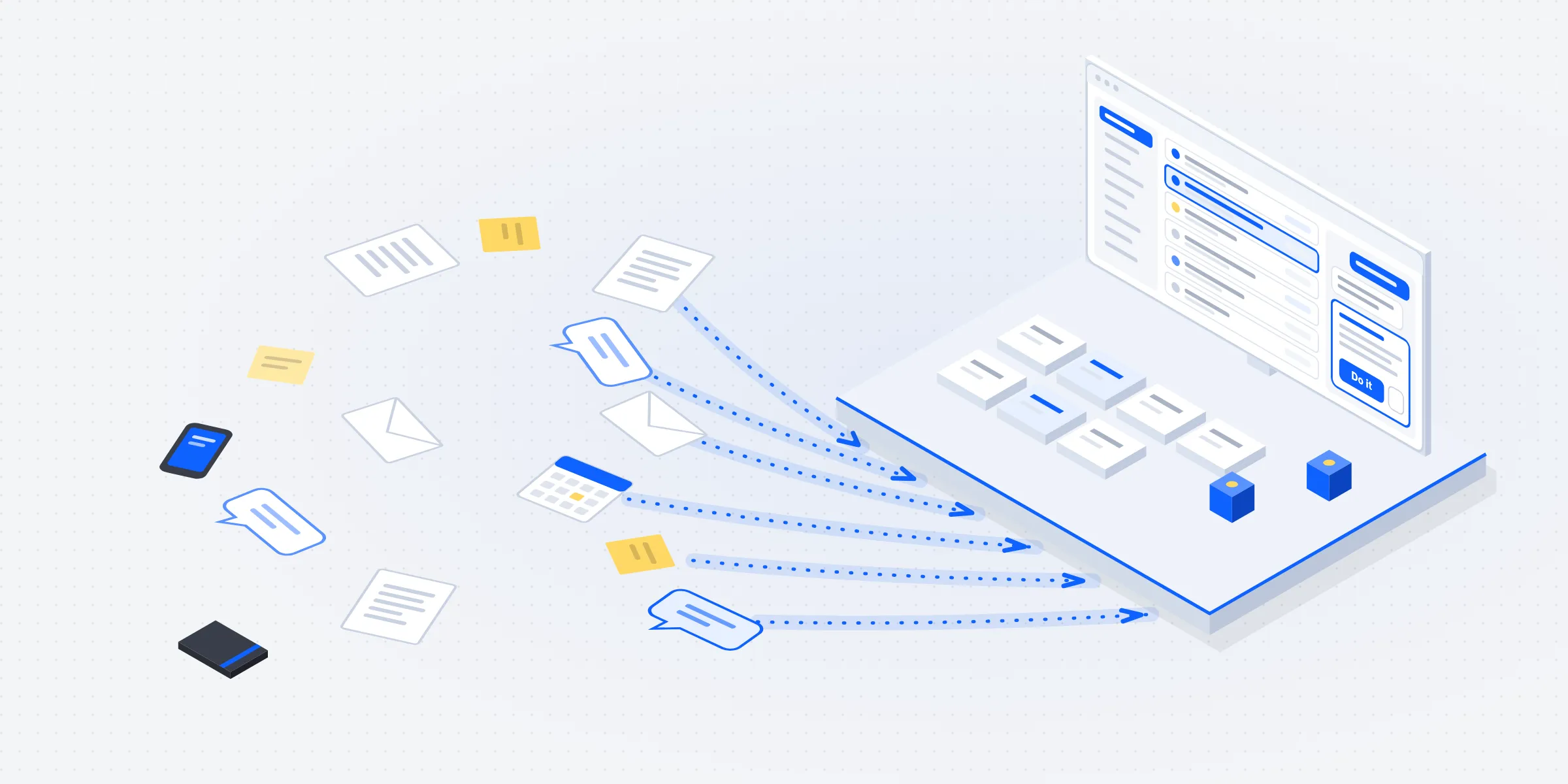
Every business already has an operating manual. It's just spread out. Some of it is in the CRM, some in a notes app, some in the calendar, and a great deal in email, in chat, and in one person's head. Every tool was built for everybody, so none of them was built for you, and the people in your business spend their day moving between them.
Orama Business is the other way to run it. We take the data your business already runs on and build a system made for your business: one place where you log in and see everything that matters, structured the way your business works. It can be small, a few records that matter most, or it can run the whole company. You choose how far to take it.
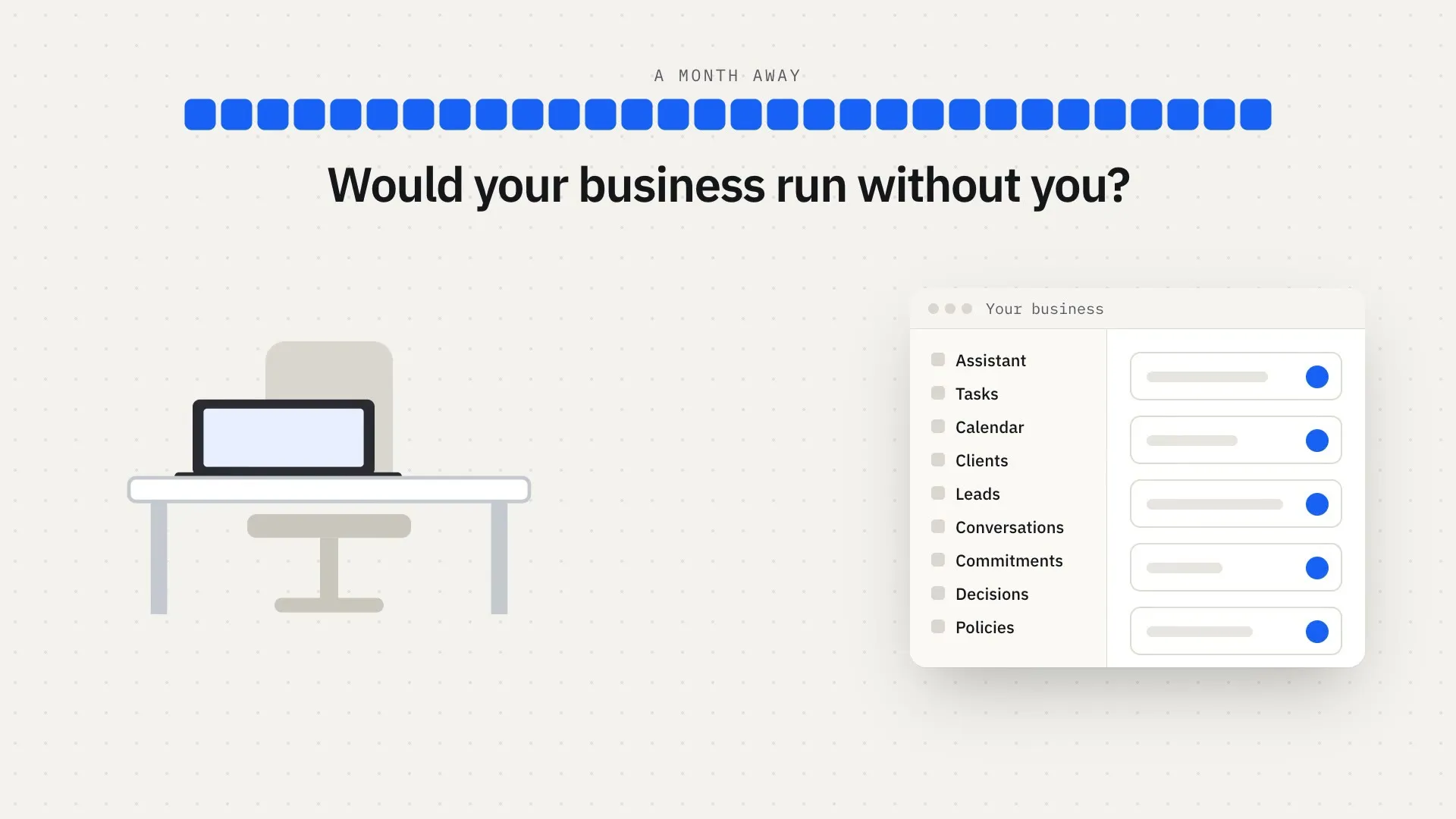
In *Would your business run without you?* I wrote that structure is the steel frame of a business: the thing that holds it up so the owner doesn't have to. Orama Business is how we build that frame, and what it's like to work inside it once it's there.1
How it starts
It starts with a conversation. We meet, and I ask pointed questions about where the most value is, in your own words. The first question is almost always the same: what's the most important object in this business? For one company it's the client. For another it's the job, the quote, the appointment, or the van. Whatever it is, that's where the system begins.
Then we take what you already have. Most businesses apologize for their mess, and every business has one. You don't need to be organized first. Your policies, processes, and know-how are usually already there, scattered across documents and conversations. We put a rope around all of that unstructured data and give it structure.
Within a few days you have a working system that you log into, start using, and give us feedback on. From there it grows a record at a time, as fast as you want it to.
Everything in one place
When you log in, the whole business is in one navigation. A typical system has an assistant at the top, then tasks, a calendar, clients, leads, conversations, touchpoints, commitments, decisions, policies, controls, processes, AI agents, requests, and the team and its roles. Yours has the records your business needs, named the way you name them. A business that only wants its appointments gets appointments. A plumbing company might want its parts, its vans, and a way to reserve them.
Some of those records are ones most businesses never keep, and they're the ones that matter most when the owner steps away:
- Decisions: what was decided, why, and what it applies to.
- Commitments: the promises made, to whom, and by when, linked to the tasks they create.
- Policies: the rules that stand, from proposed to accepted.
- Controls: how you know a policy is being followed, checked on a schedule, with a task when a check fails.
- Processes: how the work is done, with an owner and a rhythm.
Every record has its own page and its own link. You can comment on it, mention a colleague, attach files, and link it to the other systems you use. Every list can be searched, filtered, sorted, and changed in bulk. And one search box looks across everything at once: clients, leads, commitments, and every conversation.
You don't have to give up the tools you have. Your business can keep using them, and the system works around them, pulling in what matters as it changes and linking each record back to where it came from.
Your conversations become records
This is the heart of it. The company runs on transcripts.
Your people talk to customers and to each other all day. In most businesses, what was said in those conversations ends up in someone's memory, if it ends up anywhere. In Orama Business, each call or meeting becomes a transcript, and the transcript becomes records: the decisions that were made, the commitments that were given, the follow-ups that are owed, and the leads who showed interest. Duplicates are merged, so the same task doesn't appear three times because three people mentioned it.
You can also drop in a file, a recording, or a note, and dictate into any text box. Whatever comes in, the system proposes the records it implies, and a person confirms them.
The point is simple. Your people can be in front of customers instead of clicking through software all day, and nothing that was promised gets lost between the call and the follow-up.
An assistant that knows your business
The assistant is the front door. You ask it about anything in your own words:
- "What's on my plate today?"
- "Which leads haven't been followed up?"
- "Which clients need attention this week, and why?"
- "Summarize the decisions waiting on leadership."
It reads as you, so it sees what you're allowed to see and nothing more. It links every record it mentions, so you can open any of them in a click. And it changes nothing until you say so. When it wants to create a task or update a client, it shows you the change as a card, and nothing happens until you press Do it. If you change your mind, you can undo it.
Now you can chat with your business.
Beside the assistant, you can add AI agents that take on the routine work. Each agent has its own instructions, its own schedule, and its own access, and you can see what it did and what it proposes to do next. Start with one agent doing one manual job. Add more as you trust them.
Run it from Claude
Everything the system does is open to AI through MCP, the open standard that lets an AI assistant use an app's tools.2 The coverage is complete: every action you can take on the screen is also a tool an AI can use, with the same permissions you have and the same record of every change.
Through MCP you can reach the main assistant, or any of your business's AI agents. Most important, MCP lets you operate Orama Business from Claude or Claude Code, or from any agent that supports MCP. You don't have to open the app at all. Ask Claude for your highest-value leads, have it log the call you just finished, or have it write the follow-ups from this morning's meeting, and it works in your system, as you.
There's an API too, documented in full, so your developers and your other tools can do everything a person can.
Every change on the record
A system you run your business on has to be one you can trust, so every change is on the record. The business log keeps every change to everything: who or what made it, through which channel, and what it was before. If the assistant, an agent, a sync from another tool, or a person changed a record, you can see it, and you can export the whole log.
Access follows the people. Each person signs in as themselves, with a role, and sees what their role allows. The assistant and the agents work within the same limits.
Every system comes with its own guide: a page for each part, searchable, with a question mark on every screen that opens the right page.
It changes when you do
Because it's made for your business, it changes when your business does. Anyone on your team can ask for a change from inside the system, typed or dictated, the same way they'd ask a colleague. The request comes to us, we build it, and it reaches you tested.
The system grows with the business. It starts with your most important records and the work around them. As you trust it, more of the routine work moves into the system and the agents that run inside it, and your people spend their time on the work only people can do.
Yours, week to week
You own it. The code and the data are yours.
Orama Business costs 625 US dollars per week, and you can cancel any week. There's no minimum term, and the price is up front on purpose: there's very little risk in trying it. You don't hire a developer, a data scientist, or a consultant. We build it, run it, and keep it working.
To start, we meet, I ask you about your business, and within a few days you're logged in to your own system.
And when your business wants more horsepower, models trained on your own data, that's what Orama Lake is for.
Would your business run without you? With its own system, it has a much better chance.
Notes
Bibliography
- Model Context Protocol. 2026. "Specification." Version 2026-07-28. https://modelcontextprotocol.io/specification/2026-07-28.
- Sperandeo, Steve. 2026. "Would Your Business Run Without You?" Orama, November 24, 2026. https://orama.com/articles/would-your-business-run-without-you.