
Investable AI: why we built Metis
Steve Sperandeo ·
Watch the four-minute film
Most AI in business is still a skunkworks project. A small team builds a demo, the demo impresses, and a pilot gets funded on hope. That is a fine way to explore. It is a poor way to spend real money, and too many of those pilots end up as a quiet embarrassment.
We built Metis to turn AI from a speculative bet into an investment: something with a return written down before the money moves, and a plan that shows whether it is on course.
Untethered
Every AI project rests on a chain of assumptions. This data can train this model. This model will change this decision. This decision will move this outcome. This outcome is worth this much to the business.
In most projects, nobody challenges those assumptions. The work starts at the other end, with the data on hand and the question of what AI could do with it. Each link may be there, but nothing ties them to a return. The project is like a boat that was never tied to the dock: it drifts, and nobody can say where it was meant to go.
There are excellent AI platforms on the market. Without an ROI target and a plan, though, the work built on them is still untethered.
The AI score
To make AI an investment, you first need to know what a business unit can actually support. We measure that with the Corporate Intelligence Capability score, CIC for short: an AI score for a business unit. It runs from 0 to 10, and it measures how intelligently the unit can act: quality decisions, made fast, and made at scale.1
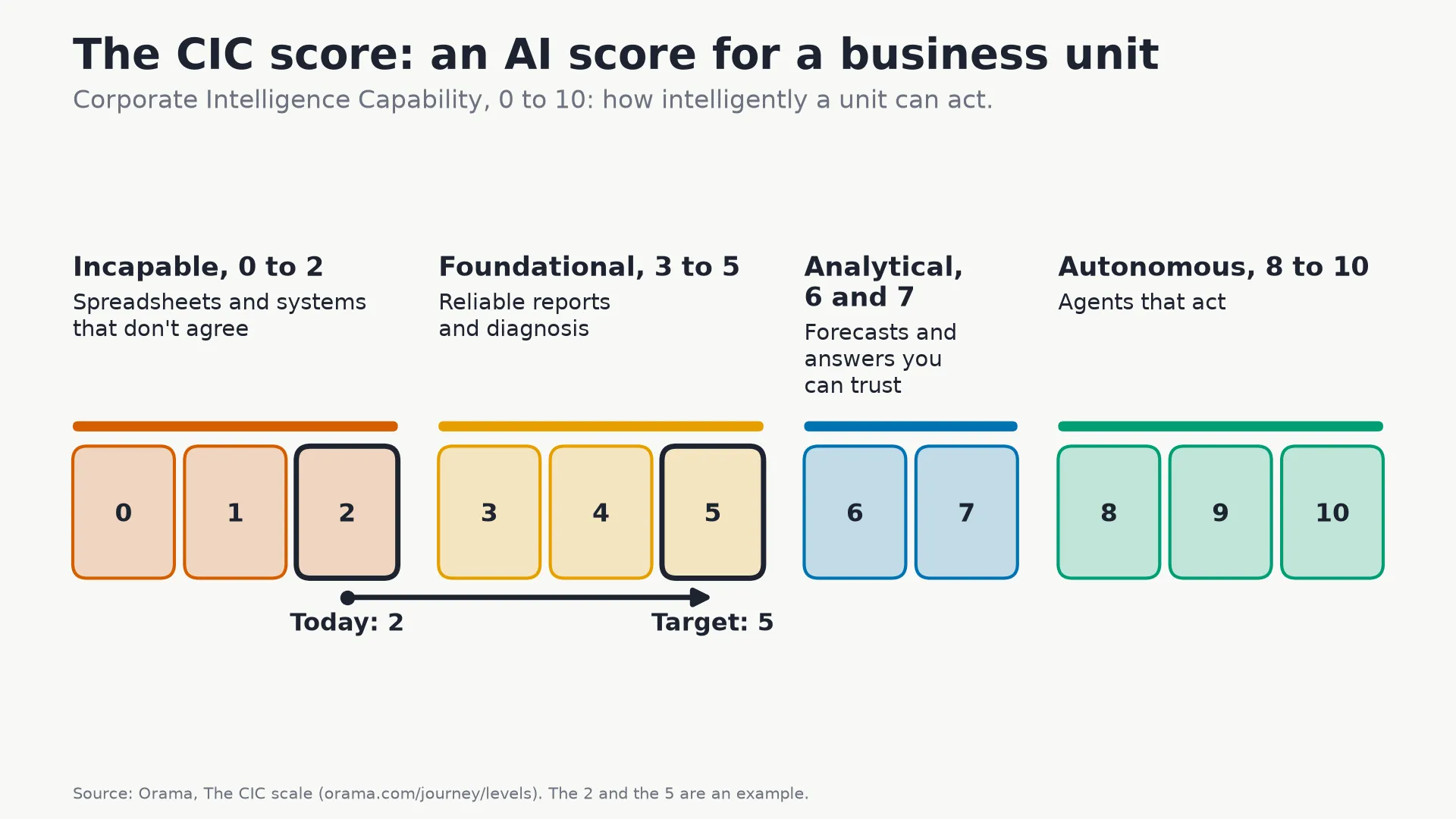
The scale has four tiers:1
- Incapable, 0 to 2. Data sits in spreadsheets and in systems that don't agree. Spend on capturing and connecting the data first.
- Foundational, 3 to 5. Reports you can rely on, and diagnosis that holds across the unit.
- Analytical, 6 and 7. Forecasts and grounded answers you can trust.
- Autonomous, 8 to 10. Agents that act, with people on the exceptions.
The score tells you which kinds of AI will work today and which won't. A pilot that needs a 7, built inside a unit at a 2, can't succeed, however good the model.
What data availability means
You can't build AI without data availability.2 Every report, model, and agent is downstream of the data it can reach, and no model can know what that data doesn't hold.
Availability is ten questions about the data a single decision needs, in three groups:3
- Can we get it, lawfully? Existence, accessibility, and permission.
- Can we trust and understand it? Quality, currency, provenance, and meaning.
- Does it serve this decision? Relevance, sufficiency, and shape.
The data is only as available as its weakest answer. A perfect dataset that you may not use for the decision scores zero.3 And the weakest answer names the fix. If a record was never captured, the fix is to build the small application that captures it.3
Data is also the one link you can check before the money is spent. That is why we check it first.
Tie it to the return
So we design the chain backwards. Start with the return: what in the business, if it improved, would move revenue, cost, or earnings? Then the outcome that would show it, in a metric the business already reports. Then the decision that drives that outcome, and the person who makes it. Then what a model would have to tell that person. Last, the data the model needs, scored on those ten questions.
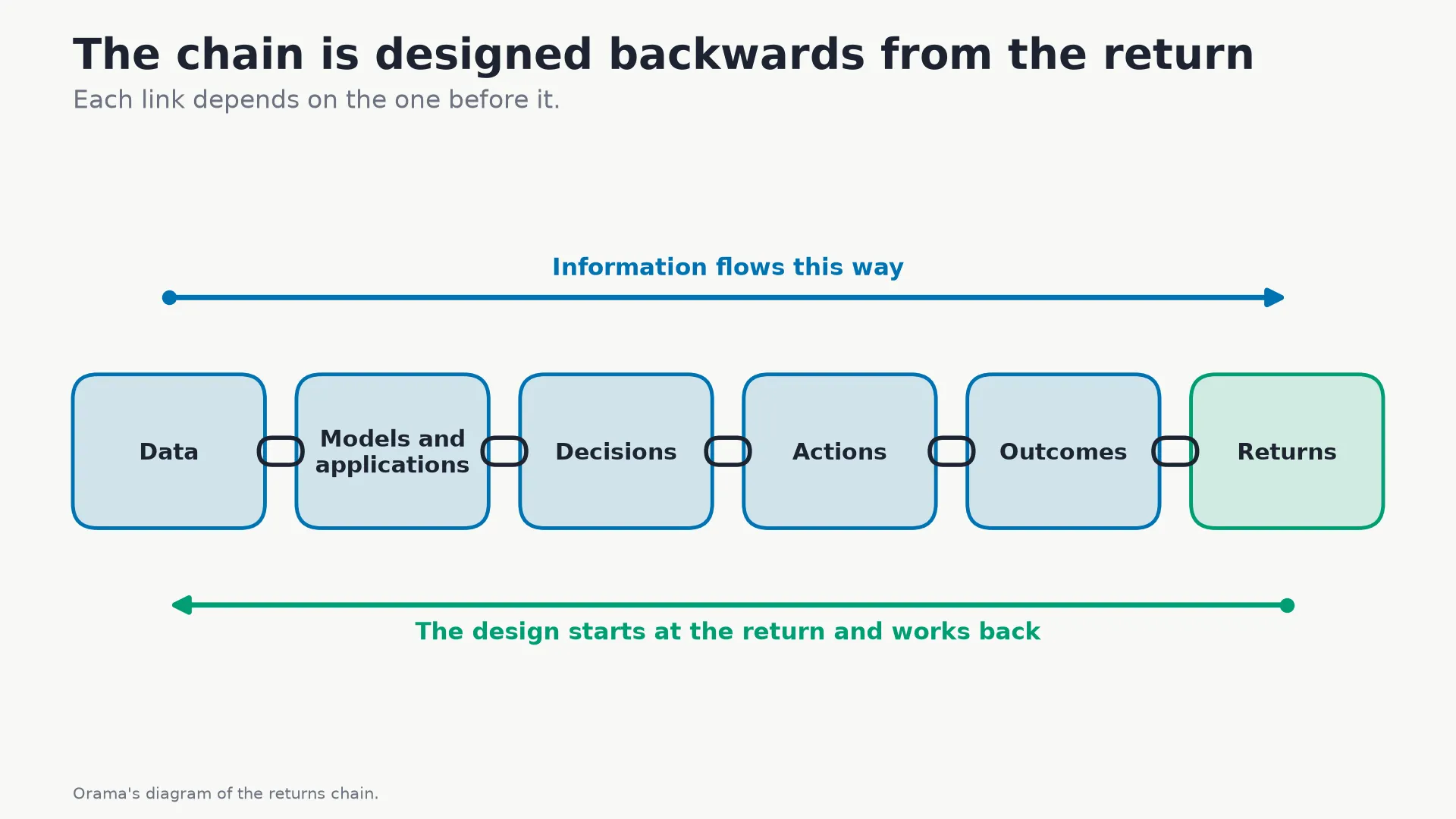
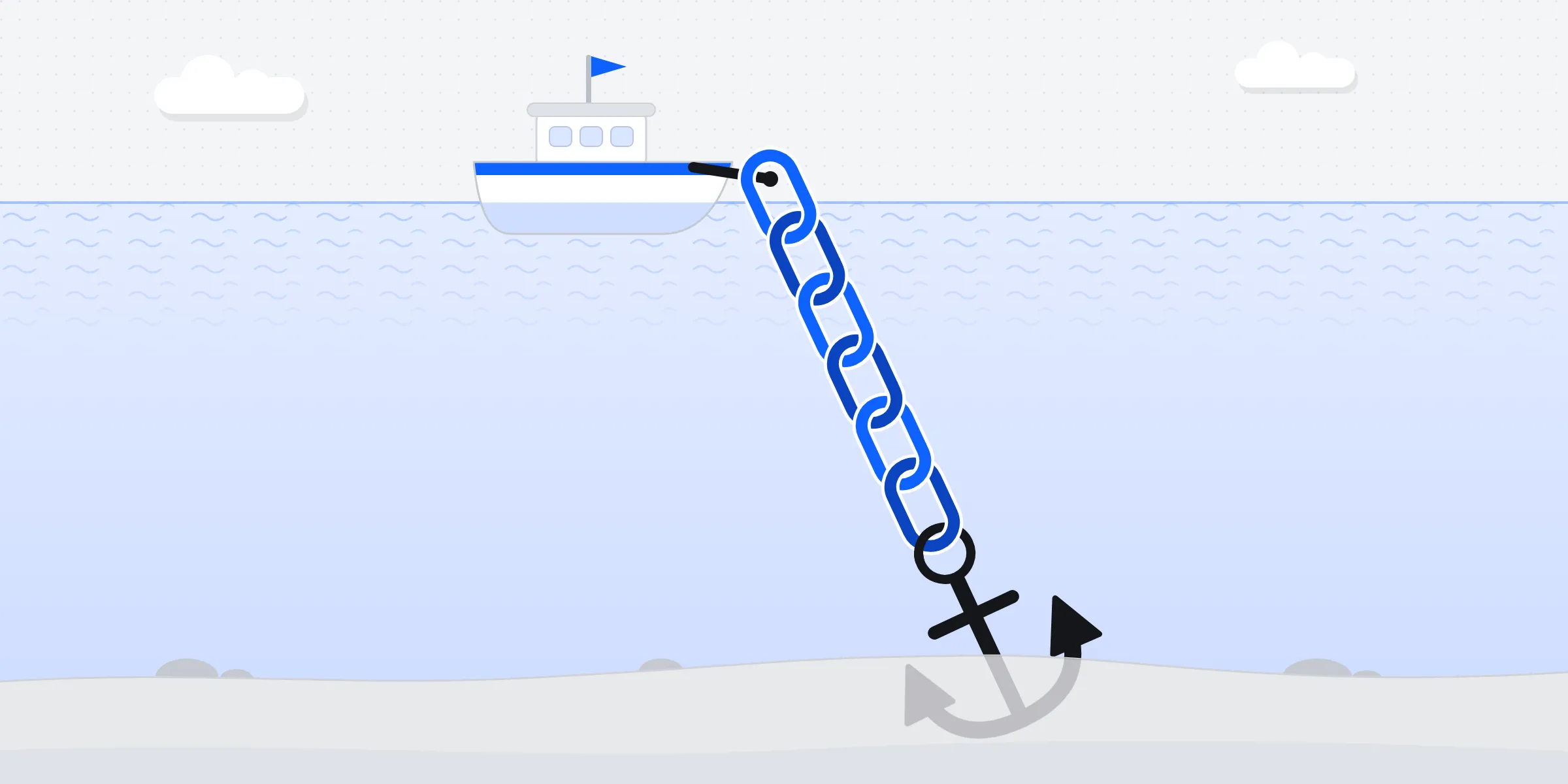
I picture an anchor and its chain. The return is the anchor. Every link back from it carries the same load, and at each one we ask whether the assumption holds and how we would know.
The investment case
That turns a pilot into an investment case: raise this unit's CIC score from a 2 to a 5, by closing these gaps, for these decisions, at this cost, to move this metric by this much. You can weigh it against any other use of the money. And it starts small: one business unit, and the few decisions that matter most to it.
Because the case is designed from the start, it has a much better chance of delivering real outcomes and a real return. Nothing is hoped for at the end; the work is built toward the return from the first day.
You also know sooner when it is going off course. Every link has its own measure: the data's scores, the decision, and the metric against its baseline. When one slips, you can see which one, while there is still time to fix it. At the end, the unit is scored again, so you can see that it moved.
And we price on results. Because the return is written down before the work starts, our price is set against it. We target a 400% return on investment over three years for each engagement, measured in the unit's own metric.2 That is a target we hold ourselves to, and no one should read it as a guarantee.
What we built
Metis is that method, run as a program: score the unit and its decisions, write the chain to the return, raise the data where it falls short, run the models the data can carry, and measure what comes back.
The software is Orama Lake, the sovereign AI stack, which we released as open source under the MIT license. Zetta, its engine, stores the data, searches it, and trains the models on it.4 So you hold the source, and it runs on your own infrastructure. The service is our engineers, who build it with your team.
The name
Metis is the Greek goddess of applied intelligence: practical wisdom, the kind that actually works. In Hesiod she is "wisest among gods and mortal men."5 That is what we want from AI in a business: less force, meaning a bigger model or more compute, and more wisdom about the decision in front of you and the data it can actually reach.
The test
Before an AI project is funded, ask three questions. What CIC score is the unit at today? What score are we paying to reach? Can we write the chain from that return back to the data, and challenge every link?
If you can answer all three, you have an investment. If you can't, you have a skunkworks experiment, and it deserves an experiment's budget.
Notes
- Orama, "The Corporate Intelligence Capability score, 0 to 10" (orama.com/journey/levels), read 2026-11-18. ↩
- Orama, "Why it works" (orama.com/theory), read 2026-11-18. ↩
- Orama, "Every step of the journey is measured" (orama.com/journey/scores), read 2026-11-18. ↩
- Orama, "Orama Lake is open source" (orama.com/articles/orama-lake-open-source), November 2026. ↩
- Hesiod, Theogony 886–887, translated by Hugh G. Evelyn-White (1914). ↩
Bibliography
- Hesiod. 1914. Theogony. In Hesiod, the Homeric Hymns and Homerica, translated by Hugh G. Evelyn-White. Cambridge, MA: Harvard University Press; London: William Heinemann. https://www.perseus.tufts.edu/hopper/text?doc=Perseus:text:1999.01.0130:card=886.
- Orama. 2026a. "Why it works." https://orama.com/theory. Accessed 2026-11-18.
- Orama. 2026b. "Orama Lake is open source." https://orama.com/articles/orama-lake-open-source.
- Orama. 2026c. "The Corporate Intelligence Capability score, 0 to 10." https://orama.com/journey/levels. Accessed 2026-11-18.
- Orama. 2026d. "Every step of the journey is measured." https://orama.com/journey/scores. Accessed 2026-11-18.