
Watch the film
Today we're releasing Orama Lake under the MIT license.12
Orama Lake is the sovereign AI stack. It's an AI easy button, with batteries included: everything you need to design, train, and ship real AI that learned on your own data, on your own hardware.
Anyone who has put AI into a real production environment knows how it goes. The demo takes an afternoon. Then the real work starts. The data can't leave the building. Security wants to know where every record goes. The model needs somewhere to run, and what it reads needs somewhere to live. There has to be search, sign-in, a place for secrets, a way to build, and a way to deploy, and each piece usually comes from somewhere different.
The AI has to come to the data. We built the whole stack as one system, so it can.
What's in it
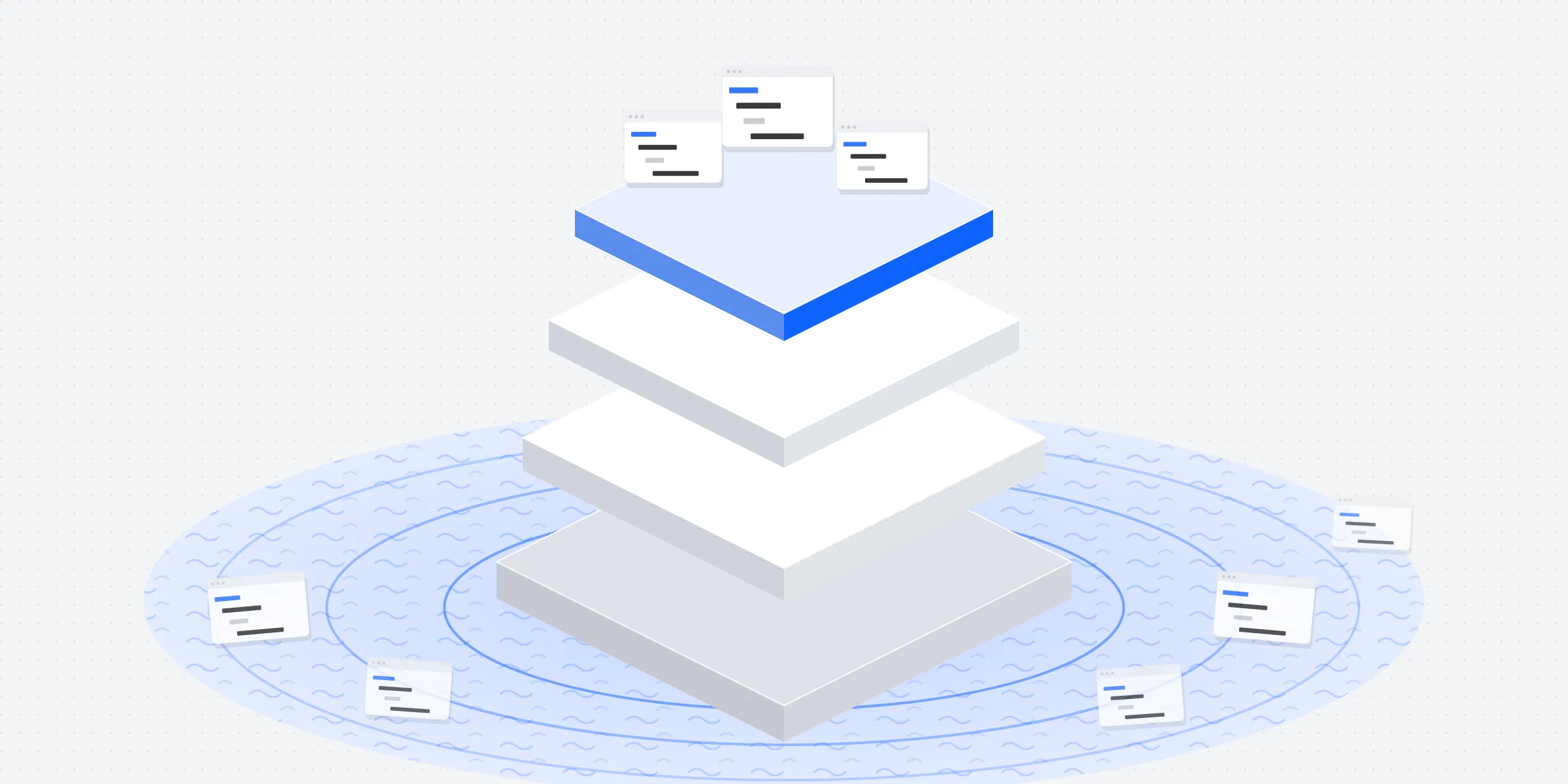
Orama Lake is four parts made to fit together, and the agents and models that run on them:3
- Lake, the workspace: agents, apps, repositories, search, files, sign-in, secrets, and a container registry, behind one API served as REST, OpenAPI, and MCP. A person, a script, and an agent all use the same API.
- Zetta, the distributed engine, written in C++26: it stores and queries your data, searches it, trains machine-learning models on it, and explains every prediction they make.
- liquid: source control, builds, packages, and deploys in one program, with every write captured and signed. It imports from Git and exports back to it.
- The operator: infrastructure as software. It runs all of it on your own Kubernetes clusters, creates the clusters, DNS records, and buckets a project needs, and keeps reconciling them while they run.
- The agents and models: the agent that builds agents, the one that builds apps, the one you ask questions, and the models they run on.
Release v0.1.1 pins Lake v0.9.0, Zetta v0.6.0, liquid v0.3.0, and the operator v0.12.0, with every other component at a released version.4 It is the same code that runs lake.live, our hosted service.3
How big it is
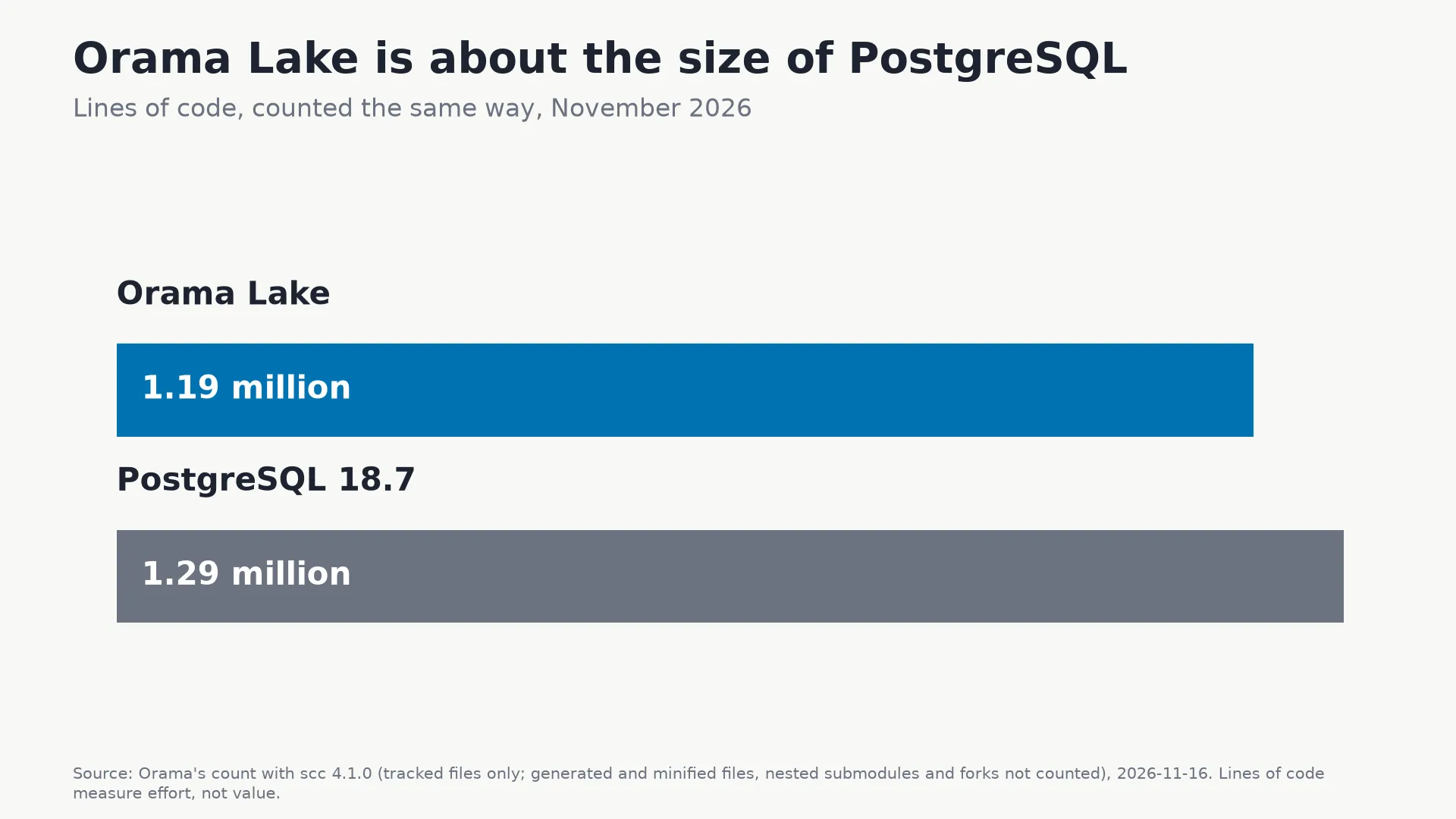
The stack is about 1.2 million lines of code we wrote, about the size of PostgreSQL counted the same way: 1,194,689 lines against PostgreSQL 18.7's 1,289,889.5
Try it
You need a Linux machine, or macOS or Windows with Docker, with at least 4 CPUs, 16 GB of memory, and 50 GB of free disk. No GPU is needed.6 Clone the repository with its submodules: git clone --recurse-submodules https://github.com/oramasearch/lake-platform.git
Then follow Try it. It starts a single-node k0s or k3s, installs the platform and the operator from the operator's helmfile, and creates one Lake, with its own workspace and Zetta. The same helmfile installs the platform on your own servers or cluster; it is the one install path.64
The license
Orama Lake is under the MIT license, one of the most permissive open-source licenses there is: free to use, and free for your developers to extend.1
Where to start
- The code and the install guides: github.com/oramasearch/lake-platform
- A security problem: [email protected], privately, never in a public issue.7
Free, sovereign AI, for everyone.
Notes
- OramaSearch, Inc. 2026e. ↩
- OramaSearch, Inc. 2026b; 2026c. Both versions were tagged on November 16, 2026. ↩
- OramaSearch, Inc. 2026a, sections Batteries included and The components. ↩
- OramaSearch, Inc. 2026c. ↩
- Orama 2026. Both counted with scc 4.1.0: tracked files only, generated and minified files skipped, nested submodules and forks not counted. ↩
- OramaSearch, Inc. 2026d. ↩
- OramaSearch, Inc. 2026f. ↩
Bibliography
- Orama. 2026. "Line Counts of Orama Lake v0.1.1 and PostgreSQL 18.7 with scc 4.1.0." Unpublished count, November 16, 2026.
- OramaSearch, Inc. 2026a. "Orama Lake." README.md, lake-platform v0.1.1. GitHub. https://github.com/oramasearch/lake-platform/blob/v0.1.1/README.md.
- ———. 2026b. "Orama Lake v0.1.0." Release notes, docs/releases/v0.1.0.md. GitHub. https://github.com/oramasearch/lake-platform/blob/v0.1.1/docs/releases/v0.1.0.md.
- ———. 2026c. "Orama Lake v0.1.1." Release notes, docs/releases/v0.1.1.md. GitHub. https://github.com/oramasearch/lake-platform/blob/v0.1.1/docs/releases/v0.1.1.md.
- ———. 2026d. "Try It: Orama Lake on a Laptop." docs/install/try-it.md, lake-platform v0.1.1. GitHub. https://github.com/oramasearch/lake-platform/blob/v0.1.1/docs/install/try-it.md.
- ———. 2026e. "MIT License." LICENSE, lake-platform v0.1.1. GitHub. https://github.com/oramasearch/lake-platform/blob/v0.1.1/LICENSE.
- ———. 2026f. "Security Policy." SECURITY.md, lake-platform v0.1.1. GitHub. https://github.com/oramasearch/lake-platform/blob/v0.1.1/SECURITY.md.