
Software is not the moat
Steve Sperandeo ·
Watch the five-minute film
For more than fifty years, software was the moat.1 Building it took years, a large team, and a lot of money, and a competitor had to spend as much to catch up. That barrier is falling fast. I think AI coding agents will cut the cost of building well-specified software by 60–80%. If so, the code no longer protects a software business.
"Software gets cheaper" is not the whole story, though. When something becomes much cheaper, the market for it rarely shrinks. The harder questions are who captures the value, and what happens to the people who used to do the work. A Victorian economist asked the same questions about coal, and his answer is a good guide to the risks and the opportunities ahead.
Jevons and the coal question
In 1865 the economist William Stanley Jevons published The Coal Question.2 Britain ran on coal, coal was finite, and the comfortable answer of the day was that better steam engines would burn less of it. Jevons disagreed:
"It is wholly a confusion of ideas to suppose that the economical use of fuel is equivalent to a diminished consumption. The very contrary is the truth."2
Each improvement made steam power cheap enough for more uses, and the new uses burned more coal than the better engines saved. This is now called the Jevons paradox.
The idea behind it is price elasticity, from introductory microeconomics. A gain in efficiency works like a price cut on what the resource provides: a cheaper mile of driving, a cheaper hour of light, a cheaper working feature. Elasticity measures how strongly demand responds to that cut. If demand is inelastic, use rises a little and total consumption still falls. The extra use takes back part of the saving, and economists call that the rebound effect. If demand is elastic enough, use rises so much that total consumption goes up. That is the Jevons paradox, which economists also call backfire. Under simple assumptions, the size of the rebound roughly equals the price elasticity of demand for the service.3
Most measured rebounds are modest. For household heating, driving, and other household energy uses in rich countries, the direct rebound is generally below 30%: people heat and drive a little more, not a lot more.4 Jevons's claim was larger. Across a whole economy, cheaper power creates new uses and new industries. The evidence for that is far from conclusive, but it suggests that economy-wide rebound is larger than economists usually assume.5
What history shows
Consider what happened when earlier technologies made something much cheaper.
- Light. In the UK, lighting in 2000 cost less than one three-thousandth of what it did in 1800, and the country used 25,000 times as much of it.6
- Farming. US farm output almost tripled from 1948 to 2017, while farm employment fell 81% and farm labor hours fell 83%.7
- Computing. Global data-center compute instances grew 550% from 2010 to 2018, while their energy use rose only 6%.8
- The internet. US newspaper advertising revenue fell from 48.7 billion dollars in 2000 to an estimated 9.6 billion dollars in 2020, about 80% in nominal dollars, as readers and advertisers moved online.9
- Printing. Book production per person in Western Europe rose many times over between the late fifteenth and eighteenth centuries.10
In each case, people started doing things they could not justify before. But no case comes down to one number: output, jobs, revenue, and profit each moved their own way. Farm output tripled while farm work collapsed. Light became nearly free, and the lamp makers did not capture the 25,000-fold growth. The same split is coming for software, so it helps to be precise about what is getting cheaper.
What really gets cheaper
Code is only part of the cost of software. Faster coding does not remove the work of checking, running, securing, or supporting what gets built.
So the 60–80% needs a denominator. Here are my planning estimates for a competent team that has spent a year or two changing how it works and uses current frontier coding models with human review. They are judgment calls, not measured industry averages:
| Area | Estimated cost reduction | What still limits it |
|---|---|---|
| Well-specified coding and prototypes | 60–80% | Unclear requirements, novel problems |
| New engineering, end to end | 35–60% | Coordination, acceptance, review |
| Testing and release | 30–50% | Independent validation, production approval |
| Maintenance | 30–55% | Undocumented rules, legacy systems |
| Customer support | 25–50% | Hard escalations, relationships |
| Implementation and onboarding | 20–40% | Messy data, organizational change |
| Planning and design | 15–30% | Customer discovery, choosing priorities |
| Security and compliance | 10–25% | Accountability, audits |
| Infrastructure and operations | 5–20% | Hosting, storage, and compute bills |
Together, these come to roughly 25–45% off the cost of building and running a whole product. The arithmetic matters. If a company spends 100 dollars, and 25 dollars of it is work that gets 80% cheaper, total spending falls by 20 dollars: 20%, not 80%.
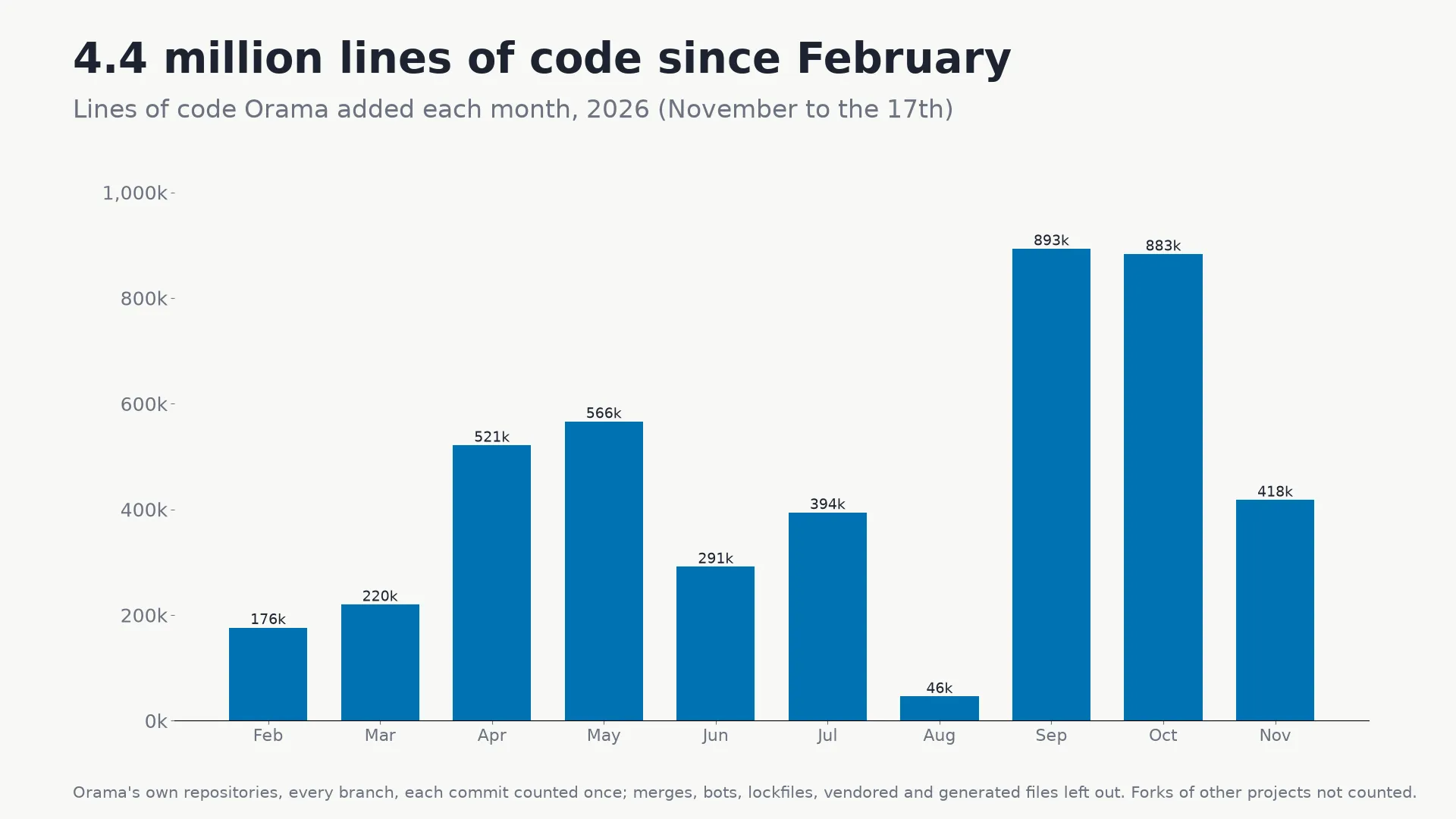
I see the change in my own company, and I doubt we are unusual. Since February, Orama has added 4.4 million lines of code across its repositories with the equivalent of about one and a half full-time developers.11 For scale, that is roughly twice the source code of PostgreSQL, counted the same way: 2.1 times, or 1.8 once rewrites and deletions are taken out.12 They show how much cheaper the writing has become.
Less capital to start
How much less money does it take to start a software company? Here is my estimate, with its assumptions stated. An early software company spends mostly on people, so assume a budget split roughly like this:
| Share of spending (assumed) | Estimated cost reduction | Points off the total |
|---|---|---|
| Engineering people, 40% | 35–60% | 14–24 |
| Other people (sales, support, operations), 30% | 20–40% | 6–12 |
| Everything else (hosting, marketing, tools, legal), 30% | −10% to +10% | −3 to +3 |
| Total | about 20–40% |
"Everything else" can rise: AI usage is a new bill that grows with the work. By my estimate, then, reaching a given milestone, such as a working product or the first million in revenue, takes roughly 20–40% less capital than it did before coding agents. That is a judgment, not a measurement.
The early evidence agrees, with a twist. A study of startups founded from 2020 to 2024 found AI-native firms about 25% smaller than comparable non-AI firms in the same industry and year, with more engineers and fewer managers and entry-level staff. Yet they raised about as much money.13 A milestone needs less capital, but investors are not putting in less. The money moves from salaries to compute and to growing faster. For the moat, the consequence is plain: if a competitor needs a fifth to two fifths less money to rebuild what you built, your head start buys less than it used to.
The rebound arithmetic
Suppose delivering a useful piece of software gets 80% cheaper, and the savings reach the buyer. How much more must people buy to keep total spending the same?
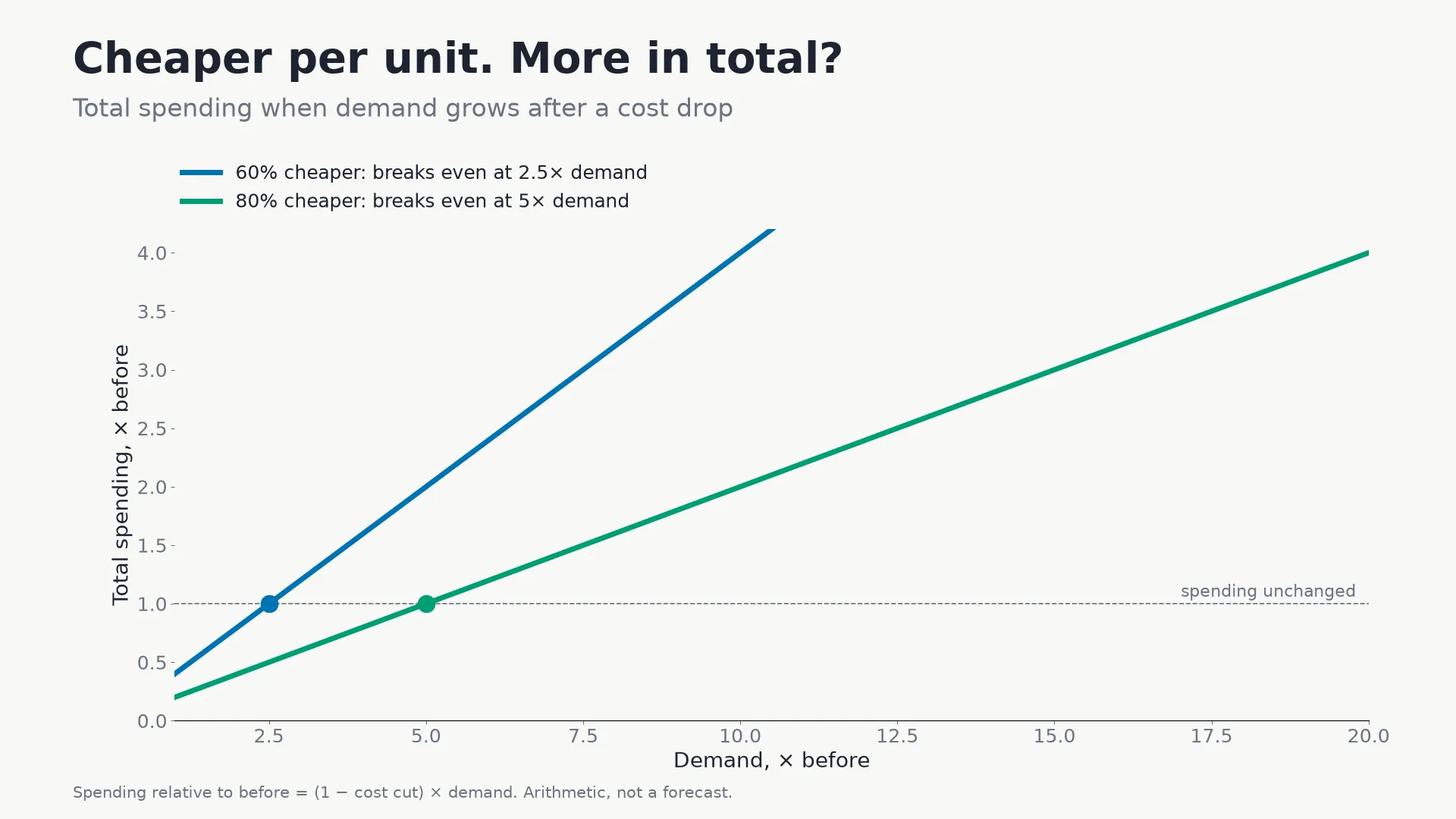
At 80% cheaper, demand must grow fivefold just to keep spending flat. At 60% cheaper, it must grow 2.5 times. Ten times the demand means twice the spending.
In the language of elasticity, fivefold is the dividing line at 80% cheaper. If demand for software grows more than that, it is elastic, and total spending on software rises. If it grows less, spending falls even as use rises.
Which resource rebounds?
That is the real question, and each resource answers it differently:
- Software in use: almost certainly more, by a lot. Custom tools for a twelve-person contractor stop being a luxury.
- Compute and electricity: likely more.
- Software vendors' profits: no guarantee at all. A feature anyone can rebuild in a week is priced like one.
- Programmer hours: uncertain. Lighting and farming went opposite ways.
The last of these matters most to the people reading this, so it deserves its own section.
Less programming, more judgment
Jevons saw the labor side too. In the same chapter he wrote that new machinery "throws labourers out of employment for the moment," but that demand for the cheapened products eventually widens employment.2 That held for coal-era Britain. Whether it holds for programmers is an open question.
Demand for programmers is what economists call derived demand: it depends on how much software people want, and on how much programming each piece of software needs. The rebound arithmetic cuts the other way for labor. If the human effort per project falls 80% and the number of projects triples, total human effort still falls 40%. A software boom can coexist with less programming work.
The work that remains, though, is the hardest part: deciding what to build, directing the agents, checking their work, and standing behind the result. A Ferrari is a powerful machine in the hands of a trained, experienced racing driver, and of little use to someone who has never driven one. Coding agents are the same: the more skilled the driver, the further the agents go. I expect fewer hours of programming, and more value in each hour of skilled judgment.
There is a catch. Junior work was how people learned the job. The AI-native firms in the study above already have a share of entry-level staff about 15% lower than their peers.13 If agents do the junior work, the industry needs another way to train the people who will supervise them.
Who gains, and who is exposed
These are my judgments, not forecasts. My rule: look for opportunity in valuable work that used to cost too much, or in bottlenecks that cheap code cannot remove. Look for risk wherever a business sells what anyone can now reproduce.
| Area | Side | Why |
|---|---|---|
| Industry-specific automation | Gains | Whole workflows in construction, logistics, accounting, and other fields, held by domain knowledge, integrations, and a record of working |
| Implementation and change | Gains | Connecting systems, cleaning data, and redesigning work, paid for results rather than code |
| Verification and security | Gains | Checking what agents do, held by independent testing, trusted records, and accountability |
| Proprietary operational data | Gains | Data that is hard to recreate, held by the rights to use it and feedback from real operations |
| Physical infrastructure | Gains | Power, grid connections, and cooling for growing computation: scarce capacity that cannot be copied |
| Ordinary businesses | Gains | Less administrative work and better service, for customers they already have |
| Easily copied software | Exposed | Competitors can rebuild the features for less, so prices and churn come under pressure |
| Outsourcing sold by the hour | Exposed | Customers need fewer billable hours for the same work |
| Per-seat pricing | Exposed | Fewer people do the same work, and agents replace some users |
| Thin AI applications | Exposed | Model providers and incumbents can add the same feature |
| Infrastructure investment | Exposed | Real demand can still bring overbuilding and weak returns |
One piece of evidence supports the first half of the table. Putting a new general-purpose technology to work takes investment around it: new processes, new skills, and reorganized work. That investment is slow and hard to measure, and productivity gains appear only after it is made.14 Code was never the whole job, and the work is moving to the rest of it.
My strongest conviction is that some of the biggest winners will be ordinary businesses that use AI, not companies that sell it. Picture a service company that automates quoting, scheduling, invoicing, and follow-up. It needs no dominant software platform. It needs lower costs, fewer errors, and happier customers. How long it keeps the advantage depends on how fast its competitors follow.
The biggest trap is confusing growth with returns. AI use can grow enormously while competition, capital spending, and falling prices absorb most of the gain. Jevons tells you about consumption, not about what any one business is worth.
Society faces a trade-off too. Cheaper tools spread access, but they can also concentrate power in whoever owns the infrastructure, the distribution, or the valuable data.
To tell which side a business is on, ask five questions:
- What becomes abundant? If you mainly sell code or routine information work, expect price pressure.
- What stays scarce? Data, trust, permissions, access to customers, and physical capacity.
- Who keeps the savings: you, your customer, or a competitor who forces prices down?
- Does demand grow enough to make up for lower prices?
- What happens when it fails? Responsibility matters more once software acts instead of advising.
My central forecast: AI will make building cheaper faster than it makes changing organizations easy. That puts the opportunity in delivering dependable outcomes, and the risk in selling inputs anyone can reproduce.
So what is the moat?
If code is cheap to reproduce, the advantage moves to what stays scarce. In my view, the top two are data and talent:
- Data: proprietary data, and the rights to use it.
- Talent: the drivers, in the sense above: people with the judgment to get the most from the tools.
- Integration: a place in how a customer works.
- Trust: security, accountability, and a record of being right.
- Distribution: access to customers, and the relationship with them.
- Delivery: the ability to turn abundant code into outcomes people adopt and keep.
Software is not the moat. It was. Now it's the water everyone gets to swim in.
Summary
AI coding agents are making well-specified software much cheaper to build: by my estimate, 60–80% cheaper for the code itself, and 25–45% cheaper across the whole life of a product. Code that cheap to reproduce no longer protects the business that wrote it.
History says cheaper does not mean smaller. Jevons saw it with coal, and it happened again with light, farming, computing, the internet, and printing: when something becomes much cheaper, people find far more uses for it. But output, jobs, and profits each moved their own way. More software in use is likely; higher vendor profits are not. Programming work will probably shrink, while skilled judgment becomes worth more.
Starting a software company now takes roughly 20–40% less capital, so a head start buys less. The opportunity lies in work that used to cost too much, and in what cheap code cannot fix. The risk lies in selling what anyone can now reproduce, and in confusing growth with returns.
The moat moves to what stays scarce: data first, then talent, then integration, trust, distribution, and delivery.
Notes
- Grad, oral history, Computer History Museum (2007): IBM announced the unbundling on June 23, 1969, effective January 1, 1970. Independent programming firms existed earlier, from 1955. ↩
- Jevons, The Coal Question (1865), chapter VII, "Of the Economy of Fuel". ↩
- Sorrell and Dimitropoulos, "The rebound effect: Microeconomic definitions, limitations and extensions" (2008); the approximation is Khazzoom's definition, which the paper examines and qualifies. ↩
- Sorrell, Dimitropoulos and Sommerville, "Empirical estimates of the direct rebound effect: A review" (2009). ↩
- Sorrell, "Jevons' Paradox revisited" (2009). ↩
- Fouquet and Pearson, "Seven centuries of energy services" (2006). ↩
- USDA Economic Research Service, Amber Waves, February 2022. ↩
- Masanet, Shehabi, Lei, Smith and Koomey, Science (2020). ↩
- Pew Research Center, Newspapers Fact Sheet (2023). ↩
- Buringh and van Zanden, Journal of Economic History (2009). ↩
- Orama's own count, 2026-11-17; method in the bibliography. The developer figure is Steve's own. ↩
- Orama's own count against PostgreSQL 18.7 (tag REL_18_7), 2026-11-17; method in the bibliography. ↩
- Kim and Koning, "AI-Native Firms," Harvard Business School Working Paper 26-090 (June 2026). ↩
- Brynjolfsson, Rock and Syverson, "The Productivity J-Curve" (2018, revised 2020; published 2021). ↩
Bibliography
- Buringh, Eltjo, and Jan Luiten van Zanden. 2009. "Charting the 'Rise of the West': Manuscripts and Printed Books in Europe, a Long-Term Perspective from the Sixth through Eighteenth Centuries." The Journal of Economic History 69 (2): 409–445. https://doi.org/10.1017/S0022050709000837.
- Brynjolfsson, Erik, Daniel Rock, and Chad Syverson. 2018. "The Productivity J-Curve: How Intangibles Complement General Purpose Technologies." NBER Working Paper 25148, revised January 2020. https://doi.org/10.3386/w25148. Published in American Economic Journal: Macroeconomics 13 (1): 333–372 (2021).
- Fouquet, Roger, and Peter J. G. Pearson. 2006. "Seven Centuries of Energy Services: The Price and Use of Light in the United Kingdom (1300–2000)." The Energy Journal 27 (1). https://doi.org/10.5547/ISSN0195-6574-EJ-Vol27-No1-8.
- Grad, Burton. 2007. "Oral History of Burton Grad (IBM)." Interviewed by Ed LaHay, November 28, 2007. Computer History Museum, CHM reference X4362.2008. http://archive.computerhistory.org/resources/text/Oral_History/Grad_Burt/102701925.05.01.acc.pdf. Accessed 2026-11-17.
- Jevons, William Stanley. 1865. The Coal Question: An Inquiry Concerning the Progress of the Nation, and the Probable Exhaustion of Our Coal-Mines. London: Macmillan. Chapter VII, "Of the Economy of Fuel." https://www.econlib.org/library/YPDBooks/Jevons/jvnCQ.html?chapter_num=9.
- Kim, Hyunjin, and Rembrand Koning. 2026. "AI-Native Firms." Harvard Business School Working Paper 26-090, June 9, 2026. https://www.hbs.edu/ris/Publication%20Files/26-090_96f92aa0-37d9-4789-beaa-5c0cb87a4032.pdf. Accessed 2026-11-17.
- Masanet, Eric, Arman Shehabi, Nuoa Lei, Sarah Smith, and Jonathan Koomey. 2020. "Recalibrating Global Data Center Energy-Use Estimates." Science 367 (6481): 984–986. https://doi.org/10.1126/science.aba3758.
- Pew Research Center. 2023. "Newspapers Fact Sheet." https://www.pewresearch.org/journalism/fact-sheet/newspapers/. Accessed 2026-11-17.
- Sorrell, Steve, and John Dimitropoulos. 2008. "The Rebound Effect: Microeconomic Definitions, Limitations and Extensions." Ecological Economics 65 (3): 636–649. https://econpapers.repec.org/article/eeeecolec/v_3a65_3ay_3a2008_3ai_3a3_3ap_3a636-649.htm.
- Sorrell, Steve, John Dimitropoulos, and Matt Sommerville. 2009. "Empirical Estimates of the Direct Rebound Effect: A Review." Energy Policy 37 (4): 1356–1371. https://ideas.repec.org/a/eee/enepol/v37y2009i4p1356-1371.html.
- Sorrell, Steve. 2009. "Jevons' Paradox Revisited: The Evidence for Backfire from Improved Energy Efficiency." Energy Policy 37 (4): 1456–1469. https://ideas.repec.org/a/eee/enepol/v37y2009i4p1456-1469.html.
- U.S. Department of Agriculture, Economic Research Service. 2022. "Increases in Labor Quality Contributed to Growth in U.S. Agricultural Output." Amber Waves, February 2022. https://www.ers.usda.gov/amber-waves/2022/february/increases-in-labor-quality-contributed-to-growth-in-u-s-agricultural-output.
- Orama's own figures: lines of code counted from Orama's repositories with git (every branch, each commit once; merges, bots, lockfiles, vendored and generated files left out), 2026-11-17; the platform's 1.2 million lines counted with scc 4.1.0 at Orama Lake v0.1.1.
- PostgreSQL Global Development Group. 2026. PostgreSQL 18.7 (source code, tag REL_18_7). https://github.com/postgres/postgres/tree/REL_18_7. Counted by Orama on 2026-11-17 two ways, to match each comparison: every line of its code files, 2,060,166 (C, headers, SQL, Perl, scripts, parser sources), for the lines added since February; and scc 4.1.0's code lines, 1,289,889, for the platform.